Trust is not something a company can buy, borrow or barter. It has to be earned, then guarded. Roy Morgan’s latest national survey charts which brands managed that feat in 2025 and which ones fell further behind.
The 2025 results confirm a familiar leader, shifting fortunes for major banks and a sharp fall from grace for several online retailers whose rise in popularity has been matched only by a rise in distrust.
Banks bounce back into trusted territory
Australia’s biggest banks spent much of the past decade clawing back public confidence. The latest Roy Morgan figures show that effort is finally paying off. Commonwealth Bank jumped two places to land in the top five trusted brands for the first time. Westpac climbed five spots to reach fourteenth.
NAB edged higher to nineteenth. ING returned to the top twenty in twentieth place. Bendigo Bank held steady in fifteenth. The banking industry as a whole moved into net trust for the first time in years, rising ten industry-ranking places in one quarter, an unusually fast shift in sentiment.
Physical retail shines, as online retail Shein’s itself
Shoppers continue to give brick and mortar retailers the benefit of the doubt. Bunnings retained its crown as Australia’s most trusted brand for an eighth straight quarter. There’s a reason it’s one of the only Aussie stores to ever score its own spot in the famed kids show Bluey.
Meanwhile, Aldi held second, and Kmart stayed third to round off the podium.
Big W remained in the top ten, slipping only one place to seventh. JB Hi Fi and Myer again featured among the country’s most trusted names. No wonder, seeing as how physical stores – despite falling sales – are seen as reliable, consistent and transparent.
Online marketplaces tell a different story. Temu’s distrust worsened to make it the fifth most distrusted brand over the year. Amazon fell one place to tenth most distrusted. Shein slid to eleventh. Their reputations are being dragged down by concerns about poor quality goods, a lack of ethics, profit driven behaviour and unreliable service. Roy Morgan noted that the more Australians use these platforms the faster their distrust grows, a trend that has accelerated through 2025. Honestly? Thank God. The fewer folks using them the better, says I.
The top 10s
Who doesn’t love a top ten list?
Australia’s most trusted brands in 2025
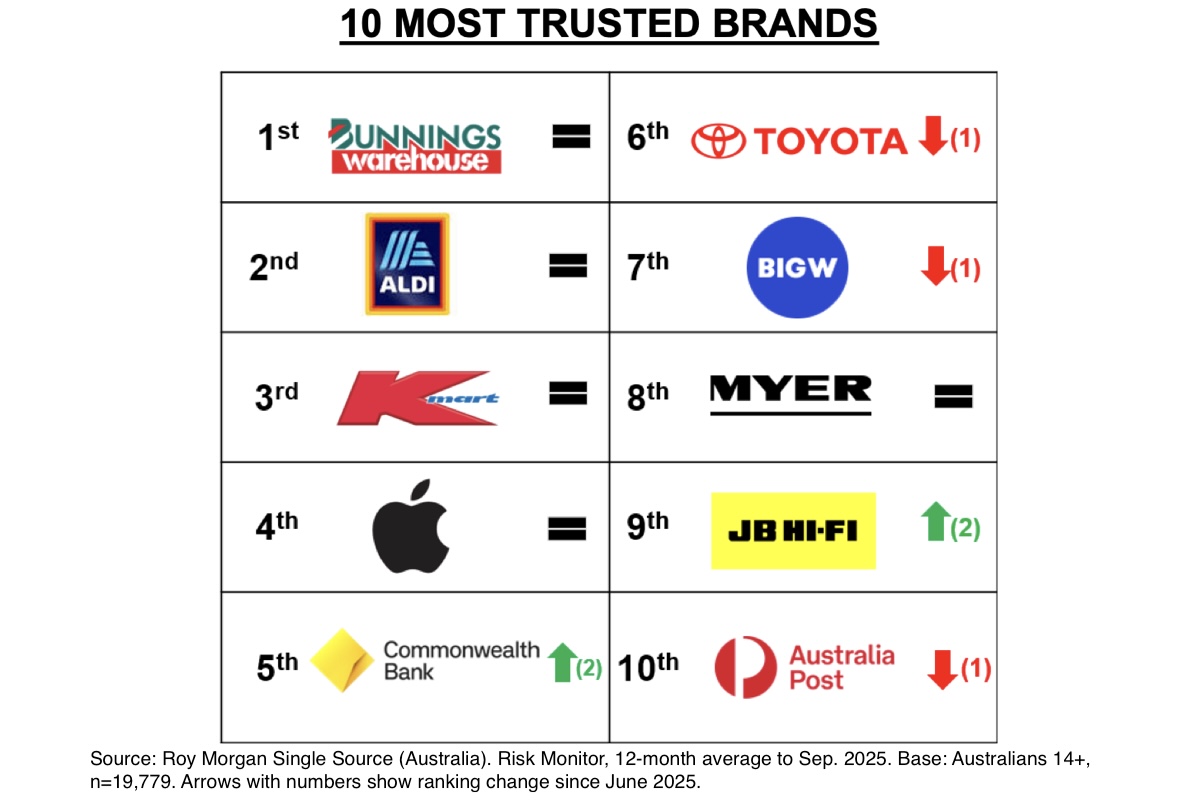
Bunnings stayed in first place. It has led the national trust rankings for eight consecutive quarters, so its position is unchanged. Aldi held second without movement. Kmart stayed in third, continuing a four quarter run in that position. Apple remained in fourth with no change. Commonwealth Bank rose two places into fifth, its highest result on record. Toyota slipped one position to sixth, pushed out of the top five by CBA’s rise. Big W fell one place to seventh. Coles held eighth without change. Woolworths held ninth. Australia Post slipped one place to tenth.
Australia’s most distrusted brands in 2025

Everyone hates the duopoly, it seems. Woolworths again ranked as the most distrusted brand in Australia. Coles remained in second, with both supermarkets holding their positions for a fourth straight quarter.
Online fast-fashion retailer and international bad guy, Temu, deteriorated one place to become the fifth most distrusted brand on a twelve month view, although it ranked as the single most distrusted brand for the month of September.
Speaking of villains, Tesla slipped one place to seventh.
2025 market-darling Telstra improved one place to eighth. Amazon meanwhile fell one place to tenth.
Outside of the top 10, Shein worsened one place to eleventh. McDonald’s deteriorated two places to sixteenth. Jetstar dropped three places to eighteenth. Shell slipped one place to nineteenth, while BP improved one place to twentieth. News Corp rose two places to twelfth.
Rio Tinto climbed one place to seventeenth.