Since the war between Iran and the US threw the global economy into a tailspin, US officials have said that the time horizon for its conclusion is measured in days. Weeks, at best.
Economists are now wondering if that timescale could be measured in many months, even years.
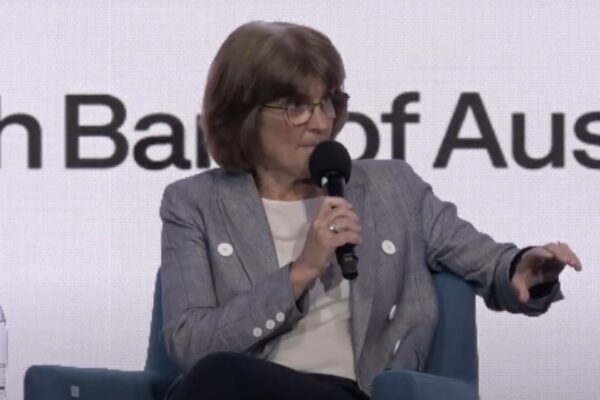
According to AMP Deputy Chief Economist Diana Mousina, the war could continue for another year without tipping Australia into recession, provided one specific condition holds: that oil resumes flowing through the Strait of Hormuz in the near term.
Speaking on Switzer TV ahead of Wednesday’s CPI release, Mousina said the recession risk is real and rising, but the trigger is supply, not duration.
“To me, the key is whether the Strait of Hormuz is open,” Mousina said. “We could see a situation where the war continues for another year, and have these disruptions up and down. But you still see the resumption of oil.”
Her reference point is the Russia–Ukraine conflict. When Putin marched troops next door, the initial commodity price shock played out over months before markets adjusted and moved on.
The war itself never ended. Indeed it continues to boil over into daily skirmishes and drone raids against Ukrainian civilians, but the economic threat dissipated once supply normalised. Mousina expects the same pattern is possible here, even without a peace deal between the US and Iran.
The window for that outcome, however, is short.
“If we don’t see the Strait of Hormuz opening, and that resumption of oil does not happen in the next few weeks, that’s when you start to get more worried about the risk of recession,” she said. “Oil is actually an input into so many different commodities and materials and transport. The flow through of that — this huge increase to oil prices and other prices — would mean a big shock to spending for consumers and businesses, higher interest rates in the short term, and a halt on spending plans.”
In other words, the war can continue almost indefinitely without forcing Australia into recession, but a closed strait cannot. A few weeks of disruption can be absorbed. A few months would be a different story.
How the war is hitting our hip pockets
The cost is already showing up in household budgets.
By Mousina’s maths, the average mortgage holder is roughly $330 a month worse off than at the start of 2026. That’s factoring in the two RBA rate hikes already delivered in February and March, plus the petrol price spike that followed the outbreak of the conflict.
“You’re still a few hundred dollars worse off than you were at the beginning of this year, and that’s a decent hit to consumers,” she said. “Maybe there are offsets: people have savings, there’s wealth effects, people are getting support from the bank of mum and dad. I’m not saying that things are going to collapse, but I think we will see some softening in retail spending over the coming months.”
Will the RBA increase interest rates in May?
The other variable in the recession equation is the RBA. Asked for her personal view on what the central bank should do at its May meeting, Mousina was direct.
“If I was in charge, then I wouldn’t be hiking interest rates right now,” she said.
Her reasoning is that the petrol price spike caused by the war is itself a form of monetary tightening. It is a cost-push shock that reduces consumer spending the same way a rate rise does, without the RBA needing to lift the cash rate. AMP’s analysis puts the size of that shock at roughly one additional rate hike. Combined with the two hikes already in the system, the mortgage belt has effectively absorbed three rounds of tightening this year, with much of it yet to flow through to the data.
That is where the recession risk compounds. The lag from the February and March hikes has not had enough time to show up in spending and labour market figures. Adding a third hike in May, on top of a cost-push shock the RBA cannot control, risks compounding a slowdown that may already be underway, and bringing forward the recession scenario that a contained war would otherwise have allowed Australia to avoid.
Mousina acknowledged the counter-argument. Underlying inflation has been creeping back up since the second half of last year. Businesses are using the war as cover to push through fuel surcharges and price increases that are not directly tied to their cost base. Wages have moved. The RBA has reasons to act.
The risk is whether action now tips the economy from a soft patch into something worse.
“Sometimes things build on themselves, and we could just see a softening in growth across the board that could lead us down that path,” she said. “It is sort of a possibility that’s there. But I think we should be pricing in the expectation that we’re going to get another rate rise in May.”
For investors, the answer to how long the war can go on is therefore conditional on two things: how quickly oil resumes flowing through the Strait of Hormuz, and how the RBA responds to today’s CPI print.
The numbers are likely to show core inflation up around 0.9 per cent over the quarter, uncomfortably high for a central bank that has hiked on the same number before.
If oil resumes within weeks, the war becomes a market story rather than an economic one, and Australia’s downturn looks shallow. If it does not, the recession question stops being hypothetical.
Watch the full interview with Diana Mousina on Switzer TV.