
Sydney and Melbourne house prices are falling, and property investors are fleeing the market since the Chalmers dropped Labor’s tax reform bombshell. With 70% of Australian household wealth tied to home values, this is a story about your financial future.
The news today tells what suburbs are copping it in Sydney and Melbourne, and undoubtedly once highly sought after similar suburbs in other states would also be seeing their prices slide. But the only positive in this very negative economic story of a Treasurer overstepping on tax reform is that it could lead to interest rate cuts faster than was expected before the Budget.
Of course, there are those who say you can’t only blame Treasurer Chalmers’ proposed property tax reforms because there has also been three rate rises this year. However, over the long term, house price rises have been defying rate rises, which the graph below shows.
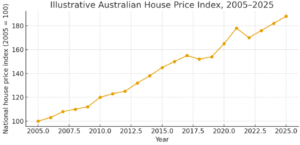
Source: whichrealestateagent.com.au
This house prices graph shows that while pandemic lockdowns helped KO prices between 2020 and 2022, from 2022 to 2025 when Dr Phil Lowe’s prediction of no rate rises until 2024 was put to the sword by his RBA, house prices kept defying gravity.
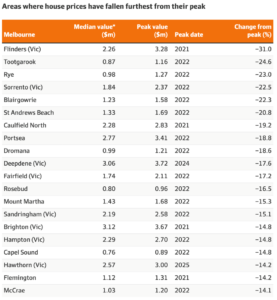
But then along came Chalmer’s Budget and this is what the AFR’s Lucy Slade is reporting, thanks to Cotality’s price-checking ability.
Here are Sydney’s price falls:
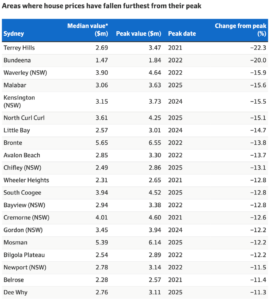
For fair reporting, what’s important to note is that the fall in prices recorded are for a longer period than just since the Budget, but I suspect if we could simply pull out the price falls since the Budget, the biggest chunk of the dive in the value of our homes would have been post-May 12 this year.
After talking with Cotality’s research director Tim Lawless, Slade told us: “The pace of housing slowdown has picked up in the last four weeks, with Sydney house prices falling 1.1 per cent, as clearance rates crash close to their lowest on record. Melbourne prices have fallen by 0.8 per cent over the same period.”
Why is this price fall happening? It’s early days but the Budget made the likelihood of property investors showing up to an auction or open house inspection very unlikely. They will be interested in new builds because with these properties they get to use negative gearing and they access the 50% capital gains tax discount.
Prices were flatlining or starting to fall before the Budget’s hit on property investors, on top of three rate rises. Combined these policies will be negative for both consumer and business spending, and should put a stop on the RBA’s rate rises. And if the impact on the overall economy is to slow down growth, then a rate cut might come sooner than has been generally expected.
If the above happens, the wealth effect will be negative and the economy will see lower spending and growth.
This chart shows how house prices and our wealth are very connected.
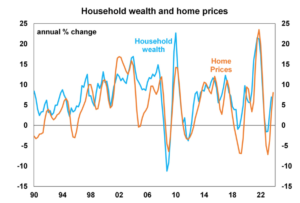
Source: AMP
Around 70% of Australian household wealth is tied to the value of homes (which is made up of land and dwellings) and moves closely in line with home prices. And the RBA should know this.
Today we’ll see the May CPI, which will be high because of the Iran war’s impact on petrol and other prices. And then we get the May unemployment numbers, which will certainly lead to a lot of interest rate speculation.
Given what economic readings are revealing, the popularity of the Albanese Government is likely to fall more and should make Pauline Hanson more popular.
As we’ve seen in the US with Donald Trump, and now in the UK where Prime Minister Keir Starmer has resigned to make way for a populist would-be leader in Andy Burnham, Hanson’s popularity has been fed by the failure of establishment leaders to lead effectively.
Labor here has played an anti-business and anti-investor game by being excessively pro-worker, but now the people they have sought to help will see the value of their homes sink, after they took on big debts to buy homes that now look like they were overpriced.
This Budget is going to be a vote-killer for the Government and reports that Jim Chalmers’ head could roll are starting to look more believable.


I thought more affordable housing was a good thing? Cannot have that without lower house prices.
I’m more than happy to take a $100,000 hit on the value of our family home if it makes it easier for my daughters to buy their first homes. A drop in value of our home isnt going to make a scrap of difference to our day to day living standards.
It’s common that people selling their home will most probably buy another one, and if the selling property has gone down in price so would the property the vendor is purchasing. The net resilt, which you totally ignored, is that, overall, nothing has changed.
The wealth linked to your property is an illusionary wealth, unless you convert bricks and mortar for hard cash and live on it or do reverse mortgage to spend your children’s inheritance. By the way, your children aren’t or shouldn’t be entitled to an inheritance, particularly if you worked your backside off to make that wealth. Give them an education and guidance, and if they have learned anything then they’ll make their own money. Further, given that we live longer, by the time your greedy kids get the inheritance they’ll be in their 60+ age group. And if they haven’t made by then, they’ll probably blow your inheritance.
Congratulations to Albo and Jim for having the balls to tackle and fix the problems created by Little Johnny who, incidentally, didn’t take the investors’ bonanza to an election … yet libs are calling Albo a lier for fixing the problems. Go and figure!
I think we have a winner for the fantasy post of the day. And extra points for ticking the “dripping with envy” box too
Lower house price when I purchase. Lower stamp duty. Isn’t that a good thing?
I feel sorry for Ron and Dante drinking the Albo/Chalmers kool-aid.
Economics 101 – loans are secured by assets, if the value of the asset goes down, the debt stays the same. The loan to asset ratio goes up which means the banks own more of your house than you do. Above 1.0 is technical insolvency, meaning the bank owns your house and you are still paying the debt.
All those new home buyers with 5% deposit offered by Albo are stuffed, so much for intergenerational equality.
If Ron and Dante don’t think this is possible just look at history.
The clearance rate drop has more to do with actual interest rate hikes since Feb 2026 and the fear of future increases than it has to do with the budget.
House prices are intrinsically linked to the market’s capacity to pay.
Capacity to pay is directly linked to borrowing capacity.
Before the first interest rate hike in Feb 2026, a household with $160,000 pa income was able to borrow $798,000 for a principal & interest loan @ 5.25% over a 30 year term and having annual loan repayments of approx $52,880.
Today, with interest rates having increased by 75 points to 6.0%, the same borrower can only afford to borrow $735,000.
That’s a $63,000 drop.
So when those prospective buyers go to an auction, their current bid is $63,000 less than it would have been 4 months ago.
For someone buying in Sydney where you needed, and had capacity, to borrow $1,500,000 in Feb 2026,
The interest rate rises have reduced your current borrowing capacity for the same repayments to $1,380,000
That’s a $120,000 drop in your maximum bid.
Observance of lifestyle spending habits of those complaining about being locked out of the housing market is instructive. Overseas travel, tattoos, Botox, unused pay TV and Gym subscriptions …… the list goes on!
Your home is tax fee & investors paid 50% CGT so the system has always benefited owner occupiers . Negative gearing did artificially benefit investors over occupiers so now investors need to be more concerned with returns, but government has taken a step too far & driving away investors will lead to reduction in rental housing and higher rents. If government want private owners to provide rental housing there needs to be an incentive to do this. What will be the governments answer to rental increases on top of cost of living challenges – rent control? I would have thought that was not possible but a liberal government effectively introduced those measure for commercial properties during Covid
As a property investor for 40 years these changes combined with State land tax make any further property investment unattractive
If that is the intent – congratulations
Houses were already going nowhere in some states but that’s buried in the article, but your headline is blaming Chalmers for it. Sure it iced the cake, but higher rates, inflation and lack of confidence were already eating away at prices as stated by Cotality et al.
I’m 100% behind his move on negative gearing and CGT for housing. Massive market distortion. The policy is doing what it should, leveling the playing field.
I don’t give a rat’s if my house goes down 100k as all homes will be affected to a degree. It’s relative. If I sell, the next place will also be cheaper.
If it gives my kids a better chance at buying somewhere near civilization, that’s great.
Now for what I think stinks about the policy changes.
Albo lied. Just like Howard did with his “no GST under my government”.
Those who bought recently may find themselves under water which stinks. If they lose their jobs and need to sell cheaply, its a financial disaster.
The 30% minimum CGT awful policy with no regard for your marginal rate of tax. It has nothing to do with housing affordability. It’s a blatant tax grab with a long tail.
It screws self funded retirees that need to sell down assets to stay independent and those younger people that have been piling into ETFs as a way of saving or building wealth having given up on housing.
The $250 tax break is an insult. I’d be embarrassed to even try and sell that.
If the LNP were not so incompetent at present they would be having a field day. Any wonder a dim witted bigot is preferred leader. Heaven help us if that comes to pass.