The government is asking everyone to work from home if they can to limit movement. Pumps are dry in some towns across the nation. And shipments of fuel Australia was counting on have been cancelled. What happens to the nation’s economy and the stock market if we run out of fuel during the Iran crisis?
How much fuel does Australia have left?
The Prime Minister said over the weekend that (at the time it was said) Australia has 38 days of petrol, 30 days of diesel and 30 days of jet fuel, based on the latest figures available.
Speaking in Coburg, he said:
“As of today, we have 38 days of petrol, 30 days of diesel, 30 days of jet fuel, which is an increase in what there was.”
“You’ll note that that hasn’t gone down, as what’s happening is that every single, every single, expected arrival of fuel has arrived.”
According to a site set up to help track the shortage across Australia and New Zealand – which is terrifying to watch live – it’s now at 26 days at the time of writing.
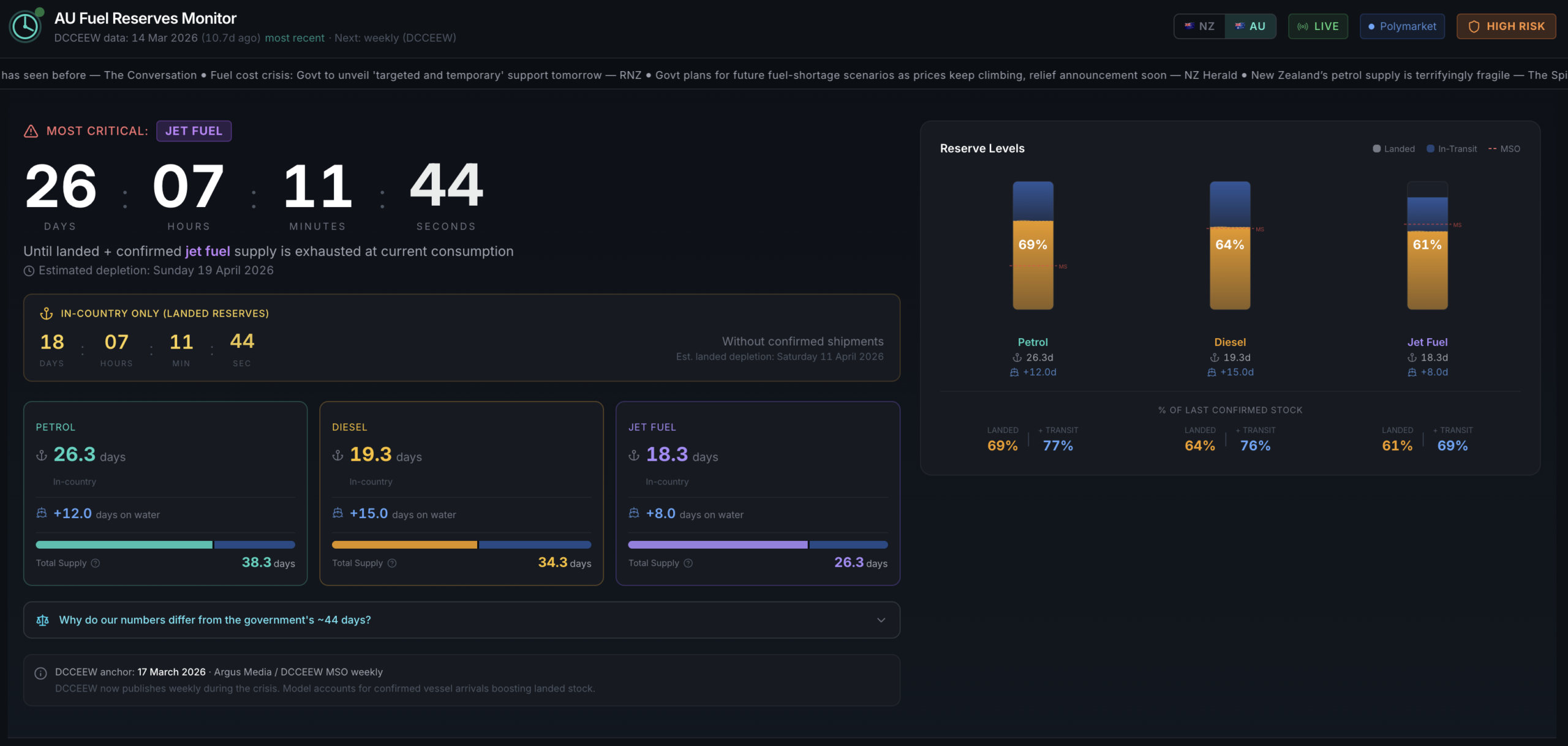
Despite the dread that image might give you, the PM has warned against panic behaviour similar to that seen when people panic-bought TP during COVID-19 lockdowns:
“There’s no case for hoarding. People filling up jerry cans, keeping fuel in your garage, a bit like what happened in COVID, people filling up their garage with toilet paper.”
“Toilet paper is less dangerous than fuel.”
Good point, PM (I guess?).
The comments come as National Cabinet meets today to discuss the situation, alongside growing attention on global supply risks and domestic distribution constraints.
The Prime Minister said fuel rationing decisions sit with state and territory governments.
“That’s a decision for State and Territory Government, so it’s not a question for me.”
What’s being done so far
Australia’s fuel supply is being supported by continued imports, domestic refining and efforts to replace disrupted shipments.
Energy Minister Chris Bowen said on ABC’s Insiders program over the weekend that Australia receives around 81 fuel shipments a month. But not all of them are making it through at the moment: six shipments have been cancelled so far, with replacements being sourced.
He said supply chains remain active despite disruptions in Asia.
“The ships continue to arrive in good numbers, and both our refineries are working absolutely full-pelt.”
“They’re both entirely 100% dedicated to Australian suppliers, not exports.”
“The flow of oil to Asian refineries has slowed and that has done with impacts on us.”
Any kind of fuel crisis is going to hit Australia particularly hard. We imports about 90 per cent of our refined fuel, according to federal government data.
Since the crisis started, regulators have moved to allow the sale of lower-quality fuel to ease supply pressure. Bowen said the system has already been tested by a surge in demand.
“We had a huge spike in demand… 100% increase in demand in a few days.”
“Whether it’s petrol, diesel, toilet paper, any commodity, a supply chain is not going to cope with that.”
He said distribution issues have been most visible in regional areas.
“The spot market hasn’t really been operating and all that’s had its biggest impact on rural and regional Australia.”
What can be done?
If the situation gets really dire, Australia has a few levers it can pull from a legal perspective to try and keep the nation moving. We have a few key national agreements, as well as a few pieces of legislation that – until now – most probably didn’t know existed.
The central mechanism is the Liquid Fuel Emergency Act 1984, which gives the federal government the power to direct fuel supply and distribution if a national emergency is declared.
It’s a big lever to pull. Bowen said the Act has never been used.
“The National Liquid Fuel Emergency Act 1984… has never been invoked, ever.”
“It’s not designed to be invoked lightly.”
The Act allows the federal government to direct supply, including prioritising fuel to critical sectors such as defence and health. Basically the government takes over who gets what first and directs it to where it’s needed most to keep basic services running.
Bowen said any decision to activate those powers would require “formal advice” (read: government lawyers) and coordination with states and territories.
“I wouldn’t exercise those quite remarkable powers unless I had pretty strong advice that it was necessary in the circumstances.”
“I would need advice… from our National Oil Supply Emergency Committee.”
Bowen said existing national arrangements also set out steps before emergency powers are used.
“There’s the national liquid emergency fuel policy response… agreed some 20 years ago.”
“It runs through the different powers that the states and territories have, the Commonwealth Minister has, what you would do before you get there – voluntary measures, encouragement, et cetera.”
He said governments are not currently planning to use those powers, however. But with the Strait of Hormuz still a figurative and literal minefield for ships looking to export crude oil out of the Middle East, who knows what could come to pass.
Alongside emergency legislation, the federal government has introduced a fuel security package, including minimum stockholding requirements for key fuels held by industry.
Under existing frameworks, state and territory governments also have powers over retail fuel access and rationing, consistent with the Prime Minister’s comments that such decisions sit at that level.
What happens to the economy in a dire fuel shortage?
Australia thankfully has limited recent experience with nationwide fuel rationing, but past events and economic research outline the effects of supply disruptions.
During the 1973 oil crisis, Australia introduced fuel conservation measures including lower speed limits and restrictions on fuel use. The period coincided with higher inflation and slower economic growth.
The Reserve Bank of Australia has research showing that increases in oil prices are associated with higher inflation and reduced economic output in Australia.
Government fuel security reviews have identified that disruptions to liquid fuel supply would affect:
- Freight and logistics
- Food distribution
- Mining and agriculture
- Aviation and transport services
Australia imports about 90 per cent of its refined fuel, according to federal government data referenced in those reviews.
International research points to similar outcomes.
The International Monetary Fund has found that oil supply shocks are associated with slower GDP growth and higher inflation across advanced economies.
The International Energy Agency has reported that supply disruptions affect transport systems, industrial production and supply chains.
Research from the United States Federal Reserve has linked oil supply shocks to declines in industrial production and employment.
More recent disruptions, however, have shown how shortages affect activity in a modern context.
During the 2021 fuel supply disruption in the United Kingdom, the Office for National Statistics reported impacts on freight, retail activity and fuel station operations.
In Sri Lanka’s 2022 fuel shortage, the World Bank reported contractions in economic output and disruptions to transport and agriculture, alongside the introduction of fuel rationing.
On financial markets, oil price shocks have coincided with declines in broad equity indices. During the 2008 oil price surge, the S&P/ASX 200 fell alongside global markets as energy costs rose.
And stock markets hate this kind of uncertainty. During the ’73 oil crisis in the US, the S&P500 fell almost 50%. The spike in oil prices caused by the Gulf War saw markets wipe almost 20% in value. And when Russia invaded Ukraine, disrupting oil supplies to the tune of almost USD$150 per barrel, we saw an economic monster rise up to push inflation (and everyone’s rates) higher and higher.
In the meantime, to ensure the shortage doesn’t lead to further economic damage or increase safety risks for Aussies, the government has said it’s passing a bucket around to our neighbours in Asia to see if anyone has any to spare.