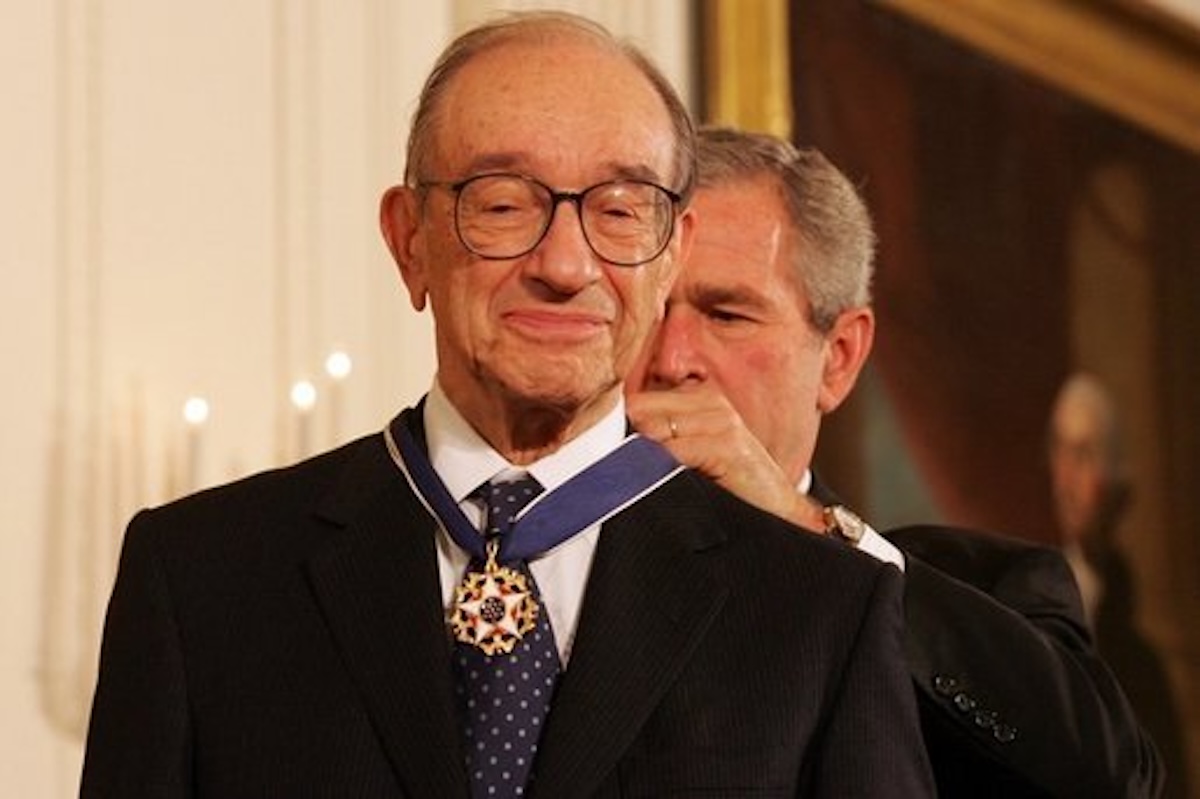
Alan Greenspan, who led the United States Federal Reserve for more than 18 years and was widely described as the most powerful central banker of his era, has passed away aged-100. The record he left behind still divides the people who lived through it.
His wife, the NBC journalist Andrea Mitchell, said Greenspan died on Monday at home from complications of Parkinson’s disease.
Greenspan ran the Fed from August 1987 to January 2006, appointed by Ronald Reagan and kept on by three more presidents: George H.W. Bush, Bill Clinton and George W. Bush. For most of that run he was treated as an oracle. The journalist Bob Woodward titled a book about him, simply, “Maestro”.
Before the Fed he chaired the Council of Economic Advisers under Gerald Ford and ran his own New York consulting firm. As a young man he belonged to the inner circle of the novelist Ayn Rand, and he carried her conviction that markets, left to themselves, look after themselves. That belief shaped his entire tenure.
The ‘Greenspan put’
When the stock market crashed in October 1987, about two months into his chairmanship, he pumped cash into the system and the economy held. When the hedge fund Long-Term Capital Management collapsed in 1998, the Fed brokered a rescue and cut rates.
Investors drew a lesson and gave it a name: the “Greenspan put”, the belief that the Fed would always step in to cushion a falling market. Critics argued it taught Wall Street that someone else would carry the risk.
The fight over derivatives
In the late 1990s a regulator named Brooksley Born, then head of the Commodity Futures Trading Commission, pushed to bring oversight to the fast-growing market in over-the-counter derivatives, the private contracts that let firms bet on everything from interest rates to mortgages. Greenspan opposed her, and with senior figures in the Clinton administration he helped block the move. The market stayed in the dark. A decade later those same instruments were at the centre of the 2008 financial crisis.
Low rates and the housing boom
Through the dot-com crash and the aftermath of the September 2001 attacks, Greenspan cut the Fed’s benchmark rate hard, to 1 per cent by 2003, and held it there. Cheap money helped the economy recover. It also, his critics say, poured fuel on a housing boom that became the bubble whose collapse triggered the global financial crisis. Greenspan maintained the housing bust was driven by global forces beyond the Fed’s control.
The 2008 reckoning
For most of his career Greenspan trusted banks to manage their own risks. In October 2008, with the financial system in ruins two years after he left the Fed, he sat before a congressional committee and conceded that the doctrine had failed.
He told lawmakers he was in “a state of shocked disbelief” that lending institutions had failed to protect themselves. He said he had found “a flaw” in his model of how the world worked. When the committee’s chairman put it to him that his free-market ideology had not worked, Greenspan replied: “Precisely.”
This article does not take into account the investment objectives, financial situation or particular needs of any individual. It does not constitute formal advice. Consider the appropriateness of the information before acting and, where relevant, seek professional advice.