
The Productivity Commission chair, Danielle Wood wants Jim Chalmers to boldly boost our productivity, but has she underlined why Donald Trump and Pauline Hanson have more fans nowadays?
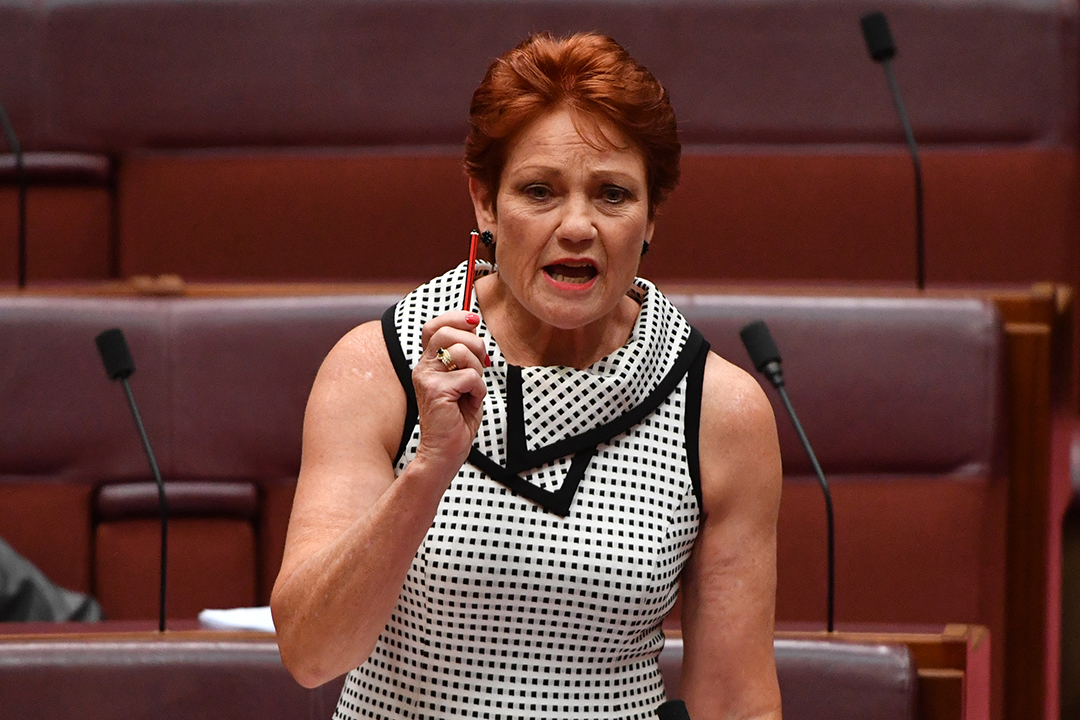
At a time when Prime Minister Anthony Albanese is channelling his inner-Bill Clinton to explain why Pauline Hanson and her One Nation party are becoming more politically popular than Labor, with this once ‘despised racist’ having parallels with President Donald Trump, the chair of the Productivity Commission helps us understand why there has been a swing globally to the right-wing of politics.
Yep, it is happening in the UK, where Nigel Farage’s Reform UK party has the support of 27.3% of voters, while Labour and the Conservatives are on 18.4%. It’s also happening in Germany and other European countries, with the polls showing discontent with their traditional leaders, and often there is a belief that immigration, climate change and other new-age social policies have “gone too far”.
They platform the belief that policies that were once seen as good and fair decades ago are now being gamed by minorities, and the majorities in these countries think the pendulum of fairness has swung too far to the left, or to the too-nice, which is imposing real-life costs on the populations of these countries.
Brexit was a line in the sand drawn by UK voters, and it shocked the then Prime Minister, David Cameron, who never thought it would get up, and so he offered the option to quieten down what he thought was a loud, protesting minority. He and others in the ruling elite learnt that there was a silent majority, and these groups have become less subdued, as the USA found out on 6 January 2021, when rioting supporters of a defeated Donald Trump in the November 2020 poll, descended on the Capitol building in Washington, claiming the election was rigged!
Over the weekend, the AFR’s economics editor, John Kehoe, looked at a piece written by Alex Sanchez in that newspaper on what is going wrong here, and why an increasing number of Aussies are cheesed off, such that they want to vote for One Nation.
Sanchez was a former economic adviser to the PM, but he thinks his old boss is making mistakes.
Kehoe summed up what is going on to explain the newfound affiliation with Pauline.
“Helping first home buyers compete against investors through tax changes to negative gearing and capital gains is Labor’s primary tool,” he noted. “The reality is Australian voters are grumpy overwhelmingly due to sticky inflation and a lack of real income growth since the 2020 pandemic, causing many to revolt against the mainstream political parties.”
Similarly, I would argue that despite good intentions to give money to low-income Australians and make homes more affordable for young property players, the economic implications of Labor’s policies have been high inflation, high interest rates and a slowing economy, which is now creating job losses.
And adding fuel to the fire is the boss of the Productivity Commission, Danielle Wood, who has implored Treasurer Jim Chalmers to be “more bold” in pressuring his own colleagues in the Federal Government and the state premiers to work on reducing red tape and other regulations that are frustrating businesses and killing productivity improvements.
Economists maintain that productivity will increase production and incomes, while bringing inflation and then interest rates down. It’s not just a cost-killer but an income generator. Am economic magic pudding!
In an essay entitled The Red Tape Impulse, Wood has asked for:
- An increase in the $900m paid to states to cut red tape and boost competition. (The Business Council of Australia wants it to be $10 billion!)
- An easing up on mandatory reporting on climate change and slavery in supply chains.
- A change in the banning of live cattle shipments.
- An end to the NSW’s late night bar lockouts as the related regulations add billions of dollars in compliance costs.
- A reform of the heavy vehicle regulations which could boost the economy by $950 million to $4 billion.
- A change of the regulations on bicycle helmets and electricity plugs to global standards, which could add $1.1 billion to $3 billion to the economy.
Wood is basically telling the governments of Australia to get real and get some guts to make changes that the economy needs, even if you offend some groups politically.
Alex Sanchez, wrote his paper for the Centre for Independent Studies to recognise the 40-year milestone of Paul Keating’s “banana republic” comment to 2UE’s John Laws on 14 May 1986. The then Treasurer Keating was making a call to all significant parties in the economy — unions, businesses, governments and ordinary Australians — that they all had to get real and embrace change.
And it was the big changes from Messrs Hawke and Keating, followed up by Howard and Costello that explained why our economy became so competitive and then went over 30 years without a technical recession. Only a Coronavirus in 2020 put paid to that achievement!
The likes of Hawke and Keating, and Tony Blair in the UK with his Third Way policy approach, which had parallels with President Clinton’s centrist approach, were all about leftish governments recognising they needed a healthy business sector to raise living standards and wealth. Many political and economic commentators nowadays believe the Albanese-Chalmers team has lost its way, where the rationally sensible approach of the famous leaders of the past, which lifted their economies and those who lived in them, has been replaced by a second-rate alternative.
“Today we are witness to the rational project being quietly displaced by a rival framework that prioritises redistribution [of income] over growth, security over competition, and the comfortable management of decline over an aspiration for improvement,” Sanchez wrote in a paper for the Centre for Independent Studies.
I would also argue that the current federal government is selecting policies that its potential voters would want, while targeting and taxing those Australians that Labor thinks will never vote for them.
I guess political parties have always targeted potential voters, but I can’t recall a government in my lifetime that is so clearly anti-baby boomers, successful small-business builders and aspirational investors, who all seem to be viewed as tax dodgers.
In fact, many of these Australians have built businesses we use and enjoy, roads and airports that add joy to our lives, have or will leave inheritances for their families, paid taxes for a long time and even have fought wars to protect our freedom.
And by the way, their investments do create jobs, pay wages and deliver places where people live.
As an Australian, who was not born with a silver spoon in my mouth, I personally despise envy politics and those who use it to cover up their shortcomings because they are not courageous, insightful and valuable leaders.
It’s because of these second-raters in power today, that unusual people, who once were seen as unacceptable, like Donald Trump and Pauline Hanson, have become increasingly popular.
(P.S. I know Trump is now unpopular because of the Iran war and its impact on petrol prices, but his rise to the presidency, twice, justifies my observation that conventional leaders’ inadequacies have made the likes of Trump and Hanson popular. It can’t be that they both have red hair, though it does challenge the old saying: “Better dead than red!”
Hi Peter,
Your comments are essentially right about the popularity of One Nation. The fact is average Australian are sick of this socialist government not listening to them.
Let’s look at what Albanese, Chalmers and Bowen have achieved since winning government.
-High inflation
-High interest rates.
-Record debt.
-High cost of living.
-Hight energy costs.
-High taxes.
-Low productivity
-Out of control immigration
Degradation of the armed forces.
Degradation of social cohesion.
Identify politics.
Record number of Public servants.
That why Australians are looking at One Nation. The Government could not run a chook raffle.
The claims against the current government completely ignore global economic realities and long-term domestic history. The inflation, high interest rates, and soaring cost of living currently affecting everyday Australians are not unique local failures. Instead, they are the direct result of worldwide post-pandemic supply chain disruptions, major global wars, and international energy shocks. Citizens in the United Kingdom, the United States, Europe, and Canada are facing identical financial pressures. Anthony Albanese and Jim Chalmers cannot control international commodity markets or global inflation. Furthermore, Australia’s current economic foundations were actually laid long before the 2022 federal election. The outgoing Liberal-National government left behind a record near-trillion-dollar debt and structural spending deficits. The recent spike in immigration is also a direct consequence of a massive post-pandemic visa backlog reopening under administrative settings inherited from that previous administration. Decades of defense procurement delays and sluggish productivity growth take generations to form, meaning they cannot be blamed on a single term of government. Australia is a small, open economy heavily exposed to international shifts, including Trump-era political volatility and foreign conflicts. Blaming domestic leaders for universal global issues is economically inaccurate, as no local government can insulate the nation from massive global macroeconomic shocks.
“I guess political parties have always targeted potential voters, but I can’t recall a government in my lifetime that is so clearly anti-baby boomers, successful small-business builders and aspirational investors, who all seem to be viewed as tax dodgers.”
This para explains the problem because albo and his crew have never “worked” for a living so they have no idea about what keeps the country ticking along,and because of this they rely too much on the inflated public service who also have no idea whats going on outside Canberra.
It is hoped the conservatives (lib,nat and one nation) get in a room somewhere and COMPROMISE enough polices to go to the next election as a conservatve front otherwise we will have this woke mob for another 3 years
I’d rather be awake to reality (woke) than closed minded. The CGT changes are nothing more than ensuring that Tax Avoidance loopholes are removed. Income is income, no matter how you paint it. You pay tax on the income you earn in a financial year. If you earn more by the sale of an asset, you pay more tax. There shouldn’t be discounts on income tax payable. Simple.
Totally Agree. Labor just wastes very large amounts of money on the climate change scare, through handing out local subsidies to local companies, for selling imported renewables products.
We should not be paying the exorbitated energy cost we have been given by Bowen.
It’s no wonder that our local manufacturing has moved offshore, and Australia ended up with a One Trillion-Dollar debt
Albo and Chalmers aren’t against Boomers and Small Business. They’re against tax loopholes. The CGT discount is a wealthy tax loophole, and although I could gain from it, I am glad to see it going. The rise of PHON is only due to the 1% pushing their rhetoric via their media channels, think, Murdoch and Packer. (Two of Australia’s worst exports in history) By closing the tax loopholes for the top 10% (that’s everyday mum and dad investor Aussies) the Oligarchy know that they’ll be next. When their mates in the LNP were of no clear use to them, ie: they have little to no chance of government in their remaining short years of life, they’ve moved to PHON to bring fear to the undereducated. By instilling fear for tax changes that do not in the slightest affect them, they gain the power to push their agenda once again. This time, further to the right. The Murdoch’s, Packers, Reinhart’s, Forests etc all fear their opulent tax avoidance is coming to an end. And it seems that Peter Switzer is not as educated as we once thought, considering he too cannot understand that income tax, taxed at an equal rate without the ability to write off to close to NIL, is a privileged handout, and not something that benefits everyday Aussies.
Albo and Chalmers aren’t against Boomers and Small Business. They’re against tax loopholes. The CGT discount is a wealthy tax loophole, and although I could gain from it, I am glad to see it going. The rise of PHON is only due to the 1% pushing their rhetoric via their media channels, think, Murdoch and Packer. (Two of Australia’s worst exports in history) By closing the tax loopholes for the top 10% (that’s everyday mum and dad investor Aussies) the Oligarchy know that they’ll be next. When their mates in the LNP were of no clear use to them, ie: they have little to no chance of government in their remaining short years of life, they’ve moved to PHON to bring fear to the undereducated. By instilling fear for tax changes that do not in the slightest affect them, they gain the power to push their agenda once again. This time, further to the right. The Murdoch’s, Packers, Reinhart’s, Forests etc all fear their opulent tax avoidance is coming to an end. And it seems that Peter Switzer is not as educated as we once thought, considering he too cannot understand that income tax, taxed at an equal rate without the ability to write off to close to NIL, is a privileged handout, and not something that benefits everyday Aussies
Well written and correct analysis of Australia today.
Hi Peter,
Albo and Chalmers think increasing productivity means taxing everyone to death so they can spend more.
The whole country is sending them a message and they are too arrogant to get it.
Albo is right on one point “It’s the economy, stupid”, the problem is he’s the stupid one. He needs a trip to Roy &HG’s room of mirrors.
Reposting as you keep deleting:
Albo and Chalmers aren’t against Boomers and Small Business. They’re against tax loopholes. The CGT discount is a wealthy tax loophole, and although I could gain from it, I am glad to see it going. The rise of PHON is only due to the 1% pushing their rhetoric via their media channels, think, Murdoch and Packer. (Two of Australia’s worst exports in history) By closing the tax loopholes for the top 10% (that’s everyday mum and dad investor Aussies) the Oligarchy know that they’ll be next. When their mates in the LNP were of no clear use to them, ie: they have little to no chance of government in their remaining short years of life, they’ve moved to PHON to bring fear to the undereducated. By instilling fear for tax changes that do not in the slightest affect them, they gain the power to push their agenda once again. This time, further to the right. The Murdoch’s, Packers, Reinhart’s, Forests etc all fear their opulent tax avoidance is coming to an end. And it seems that Peter Switzer is not as educated as we once thought, considering he too cannot understand that income tax, taxed at an equal rate without the ability to write off to close to NIL, is a privileged handout, and not something that benefits everyday Aussies.
Zac Robertson….your ignorant comments are as inaccurate as your spelling !
You wrote : The Murdoch’s, Packers, Reinhart’s, Forests ………….all misspelt !
Try instead : The Murdochs’ , The Packers’ , The Rineharts’ and The Forrests’ .
.
Until 1985 Australia had no CGT and it was only a tax grab by a LABOR mob that
introduced it and now , because of over-spending and lousy economic ability and outcomes , the current desperate LABOR mob , due to their ignorance and stupidity
and financial envy , hope to hurt their political opponents by “cracking down” on any sort of profit “that hasn’t involved physical effort” [ in their opinion , designated as
“undeserved profit” ! ] .
In reality , they will HURT THEIR OWN SUPPORTERS as much or more than their detractors , because everybody has some small heirloom or family treasure that they
had hoped to capitalise on at some future time , be it an inheritance , a hobby , a collection or a rarity …..and now that hope has been dashed ……all because of Chalmers incompetence , extravagance and arrogance ……and it is already deservedly “back firing on them” politically ! Hopefully , LABOR will ‘crash and burn’ at the next election and a NEW GOVERNMENT will repeal ALL , or at least MOST , of the recent bad legislation that this misbegotten LABOR leader and his whole incompetent crew have thrust on the Australian people ; and , hopefully , BOTH LABOR and the legislation , will be consigned to the great-green-garbage-can of history !
I just hope that they will retain-the-rage and VOTE accordingly in the future !
And , if justice is served , hopefully The Greens , The Teals and their ilk will follow suit !
.
ps……Repetition is repetition ! It does NOT constitute fact or convincing evidence …other than evidence of your frustration and your own inadequacy as an obsessive ideologue !
The Murdoch’s, Packers, Reinhart’s, Forests… how many of your ilk do they employ many thousands i would guess,dont bite the hand that feeds you.
If i start a business with my own or banks money and I am successful and build it to a point where I am employing people and looking after them and I make a lot of profit I should be able to keep the capital gains part for putting my neck on the line ,but as a public servant you probably dont understand that.
I agree with all comments except for what Zac Robertson is saying. And good on you Trevor for standing up
We all know where Zac Robertson allegiances are and his quotations are incorrect. He needs to quote factual genre rather than go on a pro Labor party rant.
That includes the global issues fella !!!! Check the actual numbers eg other country inflation that is now in check except for Australia.