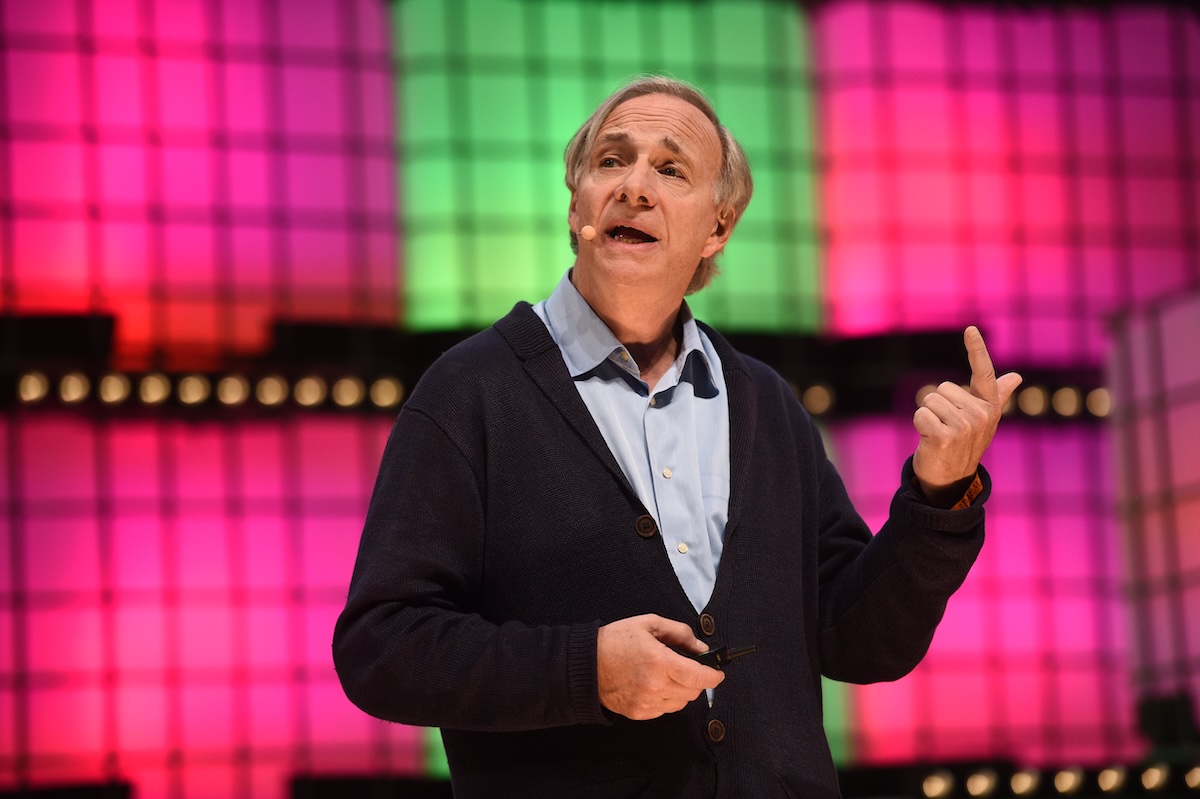
As markets are hammered all over the world, legendary investor and former CEO of Bridgewater Associates, Ray Dalio, has shared what he thinks we should be looking out for to build resilience in our portfolios.
This comes from Dalio’s extended thoughts on Twitter. While these are interesting ideas, you should remember that it’s not personalised advice that doesn’t take into account your circumstances, and that trading carries risk. Be sure you consult with a licensed financial professional before making any decisions for yourself.
1. Don’t treat cash as “safe”
At a time when investors are pulling money out of markets, Ray Dalio directly challenges the idea that cash is the safest place to be.
“While most people think the safest investment is cash… those cash investments will certainly give the lowest after-tax returns over time, and they will be especially bad… in periods of high inflation.”
Dalio’s point is precise. Cash avoids default risk, but introduces a different kind of risk, the steady loss of purchasing power. That becomes more severe when inflation is elevated, which remains a live risk in the current environment.
He is not arguing against holding cash tactically. His argument is that relying on it as a core defensive position is flawed.
“The most important thing for most investors… is a portfolio that is well diversified… and does not require market timing.”
2. Don’t rely on market timing
Dalio is blunt on one of the most common investor instincts during volatility, trying to pick when to get in and out of markets.
“Almost all investors (including most well-established professional investors) cannot time the market effectively even when they think they can.”
This is not framed as a behavioural flaw alone, but a structural limitation. Even experienced investors with resources and data struggle to do it consistently.
For Dalio, that leads to a clear conclusion. Portfolios should not depend on timing decisions to succeed.
“For most investors managing their own portfolios, investing should be done with little or no market timing.”
3. Build an ‘all-weather’ portfolio that works in all environments
Dalio’s core idea is that most portfolios are built for one type of market and break when conditions change.
“An All Weather portfolio is a passively held mix of investments that is expected to have a return that is much higher than the return on low-risk assets like cash but with much less risk than higher-risk assets… in any environment.”
He contrasts this with typical portfolios that perform well in good times but struggle when conditions deteriorate.
“This is unlike most portfolios… that do well when times are good and badly when times are bad.”
The emphasis is on balance. Not predicting which environment comes next, but preparing for all of them.
That means thinking beyond simple asset allocation and focusing on how different investments behave across changing conditions, especially shifts in growth and inflation.
4. Diversify by risk, not just by asset class
Dalio argues that simply holding different assets is not enough. True diversification comes from how those assets behave, not what they are called.
“The only way I could get this All Weather portfolio was by holding diversifying higher-returning, higher-risk investments that together would have the same higher returns with lower risk than any of them would have individually.”
The key is how those assets interact. If they respond differently to economic conditions, they can offset each other.
This led to his concept of “risk parity”.
“Taking investments of different risks… and getting them to have similar risks by increasing the risk… of low-risk investments and decreasing the risk… of high-risk investments so that they would balance each other better.”
5. Understand what drives each asset
Dalio’s approach is grounded in a simple question, what actually drives returns?
He argues that investors need to look beyond labels like “stocks” or “bonds” and focus on how assets respond to economic conditions.
“By knowing how each asset class responds to changing economic conditions like inflation and growth… I could create a passive strategic allocation mix that would be well balanced for all economic scenarios.”
He gives a clear example.
“Bonds do badly when inflation and growth rise while inflation-hedge assets like gold, inflation-indexed bonds, and commodities do well.”
6. Build a core portfolio you can hold through anything
Dalio stresses that the “all-weather” approach is not about constant adjustment. It is about having a core allocation that can be held through changing conditions.
“My All Weather Portfolio is my ideal strategic asset allocation mix of ‘betas’… that I constantly hold.”
This is deliberate. The goal is to remove the need for frequent decisions, especially under pressure.
He contrasts this with shorter-term positioning.
“While I take a lot of tactical bets… those are done by creating a well-diversified portfolio of alphas…”
7. Aim for balance, not outperformance in one scenario
Dalio’s final point is about mindset. Most portfolios are designed to perform well in a particular environment, usually one of steady growth and low inflation.
His approach rejects that.
“Having equal amounts of risk in rising and falling inflation and growth environments… I could create a… mix that would be well balanced for all economic scenarios.”
That balance comes at a cost. An all-weather portfolio is not designed to be the best performer in strong markets.
It is designed to avoid being the worst performer when conditions turn.
“What I most want is for people to understand how it works… so that they can be confident they can have good returns without being exposed to unacceptably bad performance…”