The RBA’s decision to raise rates is really an admission that both the Treasurer and the Reserve Bank Governor have not done their jobs properly.
While it’s gambling with our economic future by raising rates, the big news is that not all on the board that makes these cash rate decisions agreed with the 0.25% hike, taking the benchmark rate to 4.1%.
This revelation made me wish that the Governor of our central bank would do a Seinfeld-admission about why the board’s past efforts with interest rates have led to this.
Before I propose my script that Bullock could use to underline her honesty and help average Australians understand why home loan borrowers and small businesses with loans are set to make the belt-tightening exercises to kill inflation, I have to reveal this: the vote to raise rates was 5 to 4!
This means four members thought raising one month after they raised in February was an unnecessary move, considering this Iran war (if it goes on too long) could create a recession and rising unemployment, which usually leads to rate cuts!
In fact, Paul Bloxham, chief economist at HSBC, who thinks we might need a recession to effectively exterminate inflation, also has suggested that rate cuts might be needed by year’s end!
OK, I’ve kept you waiting too long. Now for my Seinfeld-like explanation that I’ve created for the Governor for why rates had to go up.
It could go like this: “You might have noticed we’ve been trying to beat inflation down since May 2022. And you might’ve also noticed that we’ve failed. The people on the RBA board are qualified to reduce inflation, KO unemployment and even influence the value of the Aussie dollar. So, why haven’t we been able to do that? That’s simple, it’s very, very hard!”
Let me join and suggest Bullock could have added the following on why the board has been unable to increase unemployment, which would have brought inflation into the 2-3% band. Here goes:
- They cut three times last year, which shows they didn’t see their assessment of where the economy was going was flawed.
- They didn’t work out that Jim Chalmers’ budget was blowing out, pumping up demand and fuelling inflation, which is a big mistake for economists and other charged with the job of keeping the economy out of trouble.
- President Donald Trump is a hard ‘guy’ to work out. We didn’t see this Iran war coming. It has spiked oil prices and pumped up petrol prices and inflation expectations.
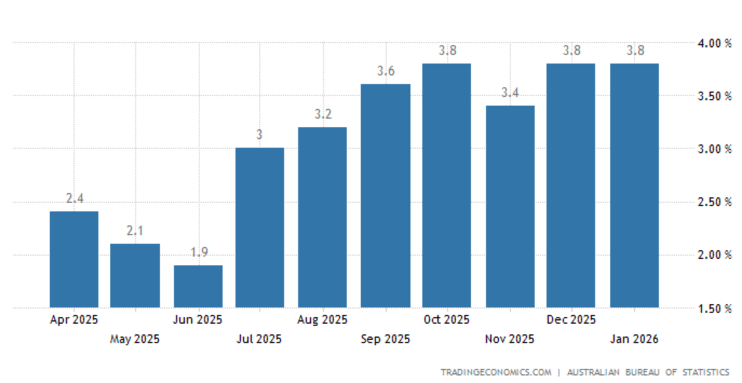
- There was political pressure on the RBA to cut rates in 2025. Why? There was an election in May last year! And the cuts started in February! Another came in May and then August. But after that, inflation started to rise in July, as the chart below shows.
- Our RBA didn’t go as hard as other central banks to kill inflation. While those economies ended up in recession, they did reduce inflation more effectively. I suspect political pressure made our RBA more ‘loveable’ to loan borrowers but now that love is on the slide, big time!
Australian Inflation
This is AMP’s Shane Oliver’s take on the decision:
“The RBA’s decision to hike rates to 4.1% was no surprise with it being about 65% factored in by the money market and 22 of the 30 economists surveyed by Bloomberg expecting a hike. The decision means that the RBA has now reversed all but one of the three rate cuts we saw last year, which of course followed 13 rate hikes seen in 2022 and 2023. Once passed on to mortgage holders, it will leave mortgage rates around levels prevailing 14 years ago. Of course, it should also mean a slight rise in bank deposit rates.”
Aside from my finger-pointing blame game about why rates were jacked up yesterday, here are a few other revelations from the RBA board meeting:
- 1. While the 5/4 vote in favour of a hike versus a hold suggests a close decision, Governor Bullock indicated that the debate was about timing not the direction of rates. In other words, while those looking for a hold were also hawkish, the four who said ‘no’ were in effect saying, ‘rates might have to go up but not now’.
- The RBA also indicated it will remain data dependent. On this front, the March quarter CPI data to be released in late April will be important.
- Shane Oliver says: “With the RBA hiking and the money market expecting nearly two more hikes by year end, interest rates in Australia are moving very differently to other major countries.”
- Oliver also pointed out: “Petrol prices have already increased by around 35% from their average in February, which, if sustained, implies a direct boost to inflation of around 1.2 percentage points, which will take it to around 5% from 3.8% year-on-year in January if prices stay around current levels.”
Did you see that?
There could be two more rate rises this year, which could leave the names Chalmers and Bullock as unforgettable figures in the memories of mortgagees and small business owners.
At times like these, those words of George Santayana, which I first saw decades ago in the memorial to Jews who suffered in the German concentration camp at Dachau, near Munich. At the end of the tour, we were reminded: “Those who cannot remember the past are condemned to repeat it.”
The upcoming May Budget will be a test for Jim Chalmers and his reputation going forward. If it is soft, interest rates will rise. If he goes hard, he could help many Aussies in both cash crises and mortgage stress.