Yesterday’s inflation figures were better than anyone expected. By the time the economists at the big four banks had finished reading them, the case for another rate rise had collapsed to zero.
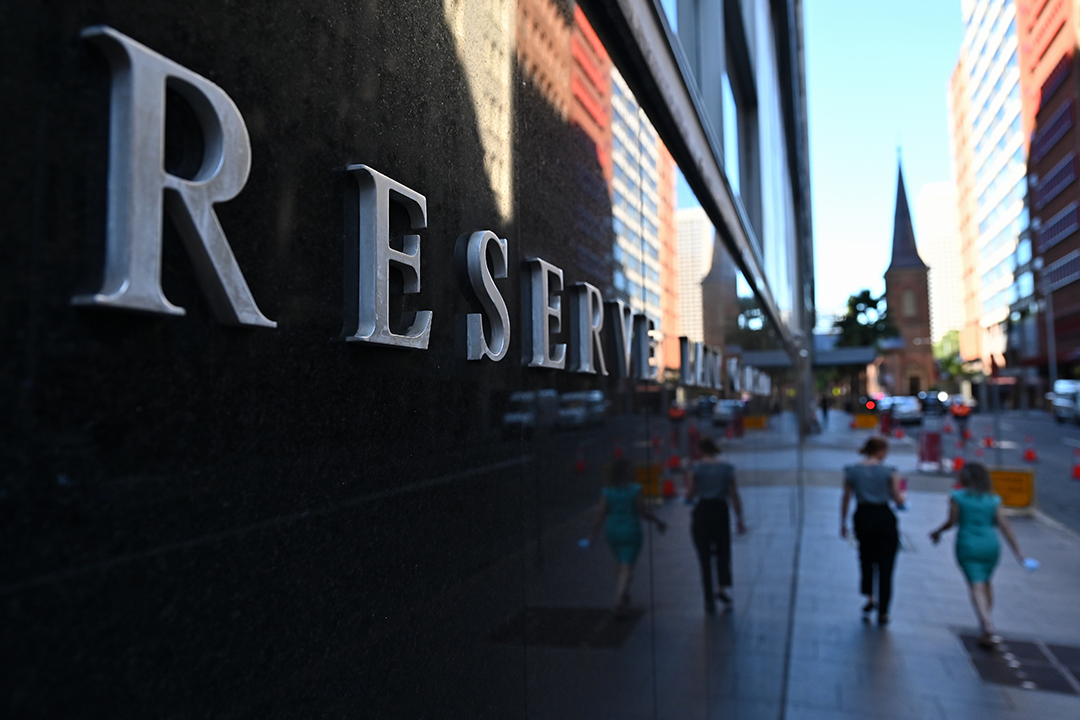
Following yesterday’s June take on inflation, the consensus view of the economics teams at the big four banks is that interest rate rises are over. The only next hope is that the Reserve Bank is just as smart when it makes a decision on rates on August 11.
So, what happened to change the view of a group of economists who thought one more rise was on the cards? Well, it was the Consumer Price Index that came in lower than expected on both quarterly and monthly numbers.
Before the data was released, the money market experts thought an August rate rise was a low 22% but now that has collapsed to zero. That means the experts who spend their lives ‘guessing’ interest rate changes think rate rises are over.
TheSMH’s respected economics correspondent Shane Wright got a great grab from Westpac’s chief economist, Luci Ellis, who once was a possible candidate for governor of the RBA before taking the top number crunching job at Westpac.
Wright reported on the once possible rate rise: “Those expectations collapsed to virtually zero after the data was released. Westpac chief economist Luci Ellis said although the RBA may debate the case for a rate hike at next month’s meeting, the case for one no longer existed.”
This close up look at what is happening to prices by the Australian Bureau of Statistics has shown that as Wright points out, across a range of goods and services including vegetables, eggs, lamb, wine, clothing for women and children, men’s shoes, furniture and household appliances, prices are falling.
And while the battle against inflation hasn’t been won with the underlying rate at 3.6% for the year, which needs to get below 3%, the trend is looking better than expected.
This is how AMP’s Shane Oliver saw the CPI figures: “Over the whole June quarter, headline inflation rose by 0.6%, well down from 1.4% last quarter and below economists’ expectations of 0.7%. It grew by 4.0% on an annual basis (from 4.1% last quarter).”
He added: “In the month of June, inflation fell by 0.1% (economists were looking for a 0.2% rise) and annual growth fell to 3.8% (from 4% last month). This is a good sign that inflation has peaked and is now coming down – you can see this in the yellow line in the chart below.”
This slowdown in price rises not only shows that the three rate rises from the RBA have helped slow down inflation, the shock effect of the Budget and its attack of investors, business and property players is probably rocking the economy’s confidence.
The best outcome of these inflation numbers and reactions from economists, which are now being reported in media outlets like this one, is that it will help turnaround the negativity that has been hurting economic growth, company performances and stock prices.
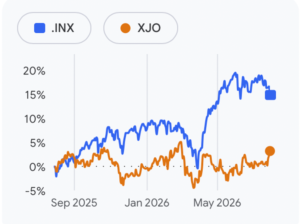
The chart below shows how the US stock market has surged 14.8% while our market is up 3.22% and it reflects how our economy and the companies within it have struggled under a federal government that fails to understand the importance of supporting business.
This could be the starting point of a turnaround for business and consumer confidence, and it’s the good news that’s desperately needed.
This week I revealed that Chris Joye’s economics team at Coolabah Capital calculated that the Budget had hit the economy like two rate rises, which on top of the three we copped from the central bank means we have been slugged five times with rate rises.
So, it’s no wonder inflation is falling.
We now have to hope that the RBA is smart enough to sit tight and give up on rate rises.