Before the 2025 election, Labor promised to cut student debt by 20%. New tax data shows exactly where those debts were biggest, and it maps neatly onto some very interesting electorates.
The Budget aimed to make houses cheaper for young people despite the current and past government’s poor performance in increasing the supply of homes, but many would-be homebuyers have a financial problem hurting their chances to get onto the property ladder, their HECS debt!
As the AFR’s Maani Truu revealed: “Some of the country’s wealthiest suburbs are also home to the steepest student debts, with the average HECS balance surpassing $38,000 in parts of Sydney’s affluent east as well as in suburbs bordering major university campuses.”
But Sydney is not alone in housing big student debt taxpayers with Melbourne competing for the country’s biggest HECS debts, and a national average of $28,500.
Sydney’s big HECS debt suburbs were, Darlington and Chippendale, which hover on Sydney University’s location, followed by Point Piper, Edgecliff and Darling Point, which could be called the grand central for wealth in NSW capital. In Melbourne suburbs close to Melbourne Uni, Collingwood, Princes Hill, Carlton North, and Docklands, had an average HECS debt of $38,000.
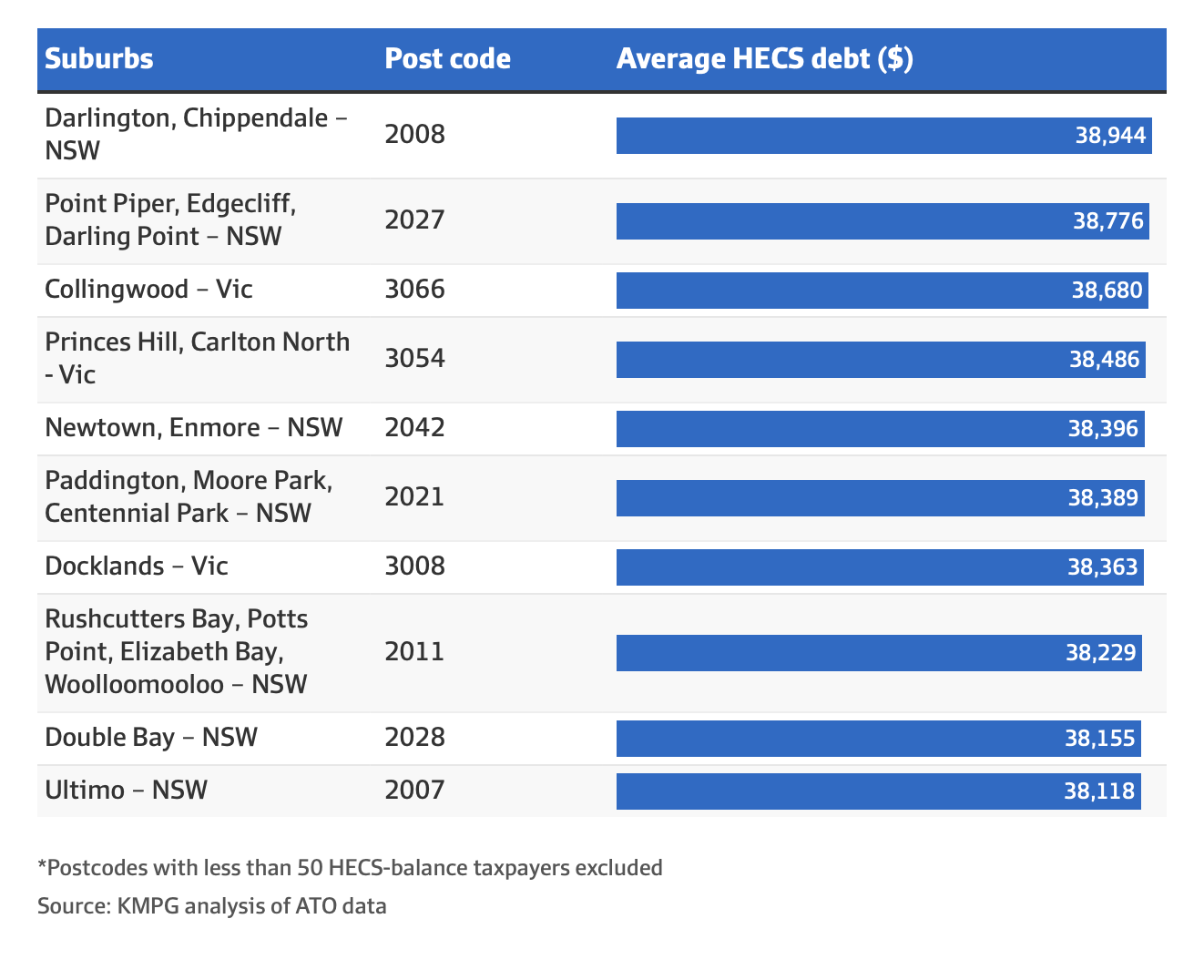
These are all tax record numbers which prevailed before the Albanese Government promised to cut pre-existing HECS debt by 20% and given the size of these debts, you can see how this would’ve been a very popular pre-election offering.
In November 2024, the Albanese Government announced it would cut 20 per cent off all student loan debts, wiping around $16 billion in student debt for around three million Australians. The election was held in May of 2025, which looks like a great vote-catching strategy.
Politics aside, the conclusion of KPMG’s urban economist Terry Rawnsley is insightful, pointing out to the AFR that the suburbs with the highest HECS balances are concentrated in areas with easy access to university and, later, well-paid jobs.
Rawnsley went further adding the following: “It’s places where people have settled, got the university degree, and it’s close to the CBD, so they’ve stayed there.” He then looked at the advantage of being at a city university over a regional one, where the city one means, “you can stay there your whole career, whereas if you’ve gone to a regional university or a university in a smaller city, you have to pick up sticks and move into the Sydney housing market, which is not an easy one to crack into.”




With the dire outlook for our economy, with horrendous debt, and the obvious inability of the government to improve our position, coupled with the stupidity of Albanese, we have the masses moving to support One Nation. Can you imagine One Nation winning government with perhaps 70 first-time politicians and an uneducated leader? Quite clearly, the future for Australia must lie with a Coalition Government. We keep hearing terms in the media, such as “irrelevance” and “terminal” when referring to them. This subtle dismissive referencing is so negative, and people have no inclination to consider them. Australia needs more responsible reporting from journalists. Can an article in your paper discuss this? Australia needs a coalition government, or we are history!