
Since the explosion of AI onto people’s laptops and phones, Software-as-a-Service (SaaS) businesses have taken a beating on the market.
Companies like Salesforce and Oracle have copped it in their share prices over AI. These businesses are taking a hammering for either not moving fast enough to embrace these AI tools for their customers, and/or because the tools to recreate them easily are now available for everyone.
How can AI kill a traditional SaaS business?
I’ve had people ask me in recent months just how the average Joe could create the next Salesforce or Oracle. While it’s not quite as cut-and-dry as building a competitor’s product better, it’s more about nibbling at the edges of an existing businesses profitability.
AI tools can be used to create – or re-create – tiny little tools that sit at the edge of a company’s value proposition that it could start to eat into their profit margins should the free alternative take off.
Canva, for example, is free to use for basic needs. As a result, it’s an existential threat to a company like Adobe, which has photo editing and image tools as part of its value proposition. Google Docs is the same, as it replicates functionality that Microsoft sells for a fee.
It’s these little things that start to erode investor confidence in a company’s product, and that erosion shows up on the market.
Recently I spotted another good example which cuts to the core of why AI is a threat to big SaaS businesses.
Docuseal vs Docusign: the battle for your signature
If you’ve ever had to sign a piece of paper digitally online, it’s a fair bet that a company called Docusign was involved.
Docusign is a company that offers a solution to sign stuff online. Rental agreements, employment contracts, confidentiality notices – you name it. It sells its tech for a fee to anyone who wants to nab your John Hancock in a quick and easy way.
But thanks to the ‘magic’ of AI, someone has built an alternative to Docusign, and is now giving it away for free.
It’s called Docuseal, and it’s $0 and completely open-sourced. That means people can create their own versions of the software under an open source license and integrate it or remix it in any way they want. And they’re doing it, too, with over 1000 different ‘forks’ of the software now in existence.
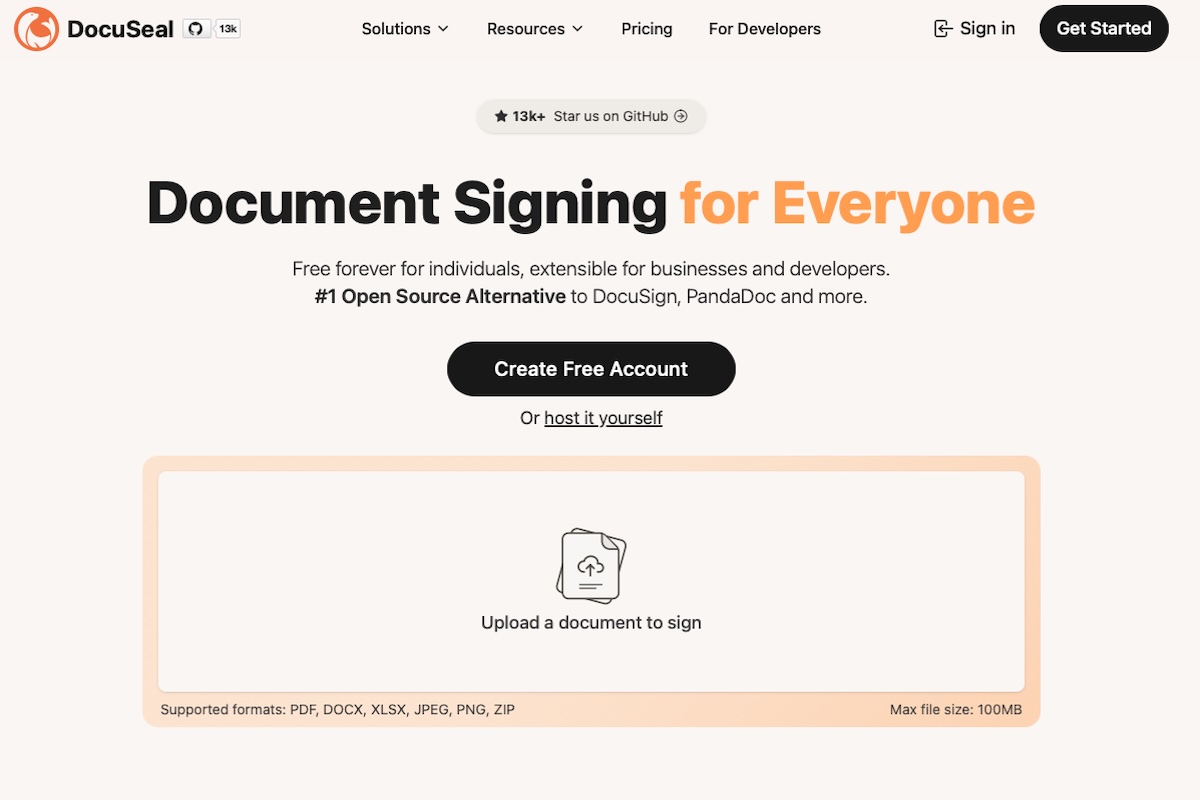
Its core proposition is exactly the same as the one Docusign charges real money for. You upload any PDF, and it turns it into a document that can be sent back and forth between parties to collect binding signatures.
There are no charges for services around it, with free messaging between parties, free ID checks and (provided you host it securely), nearly no charge for storing of documents.
As one Twitter user points out, a 50-person company could spend almost US$40,000 a year for that kind of service on a paid Docusign subscription. Or they could get it for $0 with something open source like Docuseal.
It seems almost counter-intuitive, but the Docuseal folks have even started to build a business around its free alternative as the snake begins to eat its own tail. Docuseal has a US$20/month Pro subscription that allows you to get a tonne of different integrations and support from a traditional account manager if you’re a larger business.
But it’s the perfect example of how businesses can either get on the AI train, or in the case of Docusign – which has seen its share price drop 75% since 2021 – get run over by it.