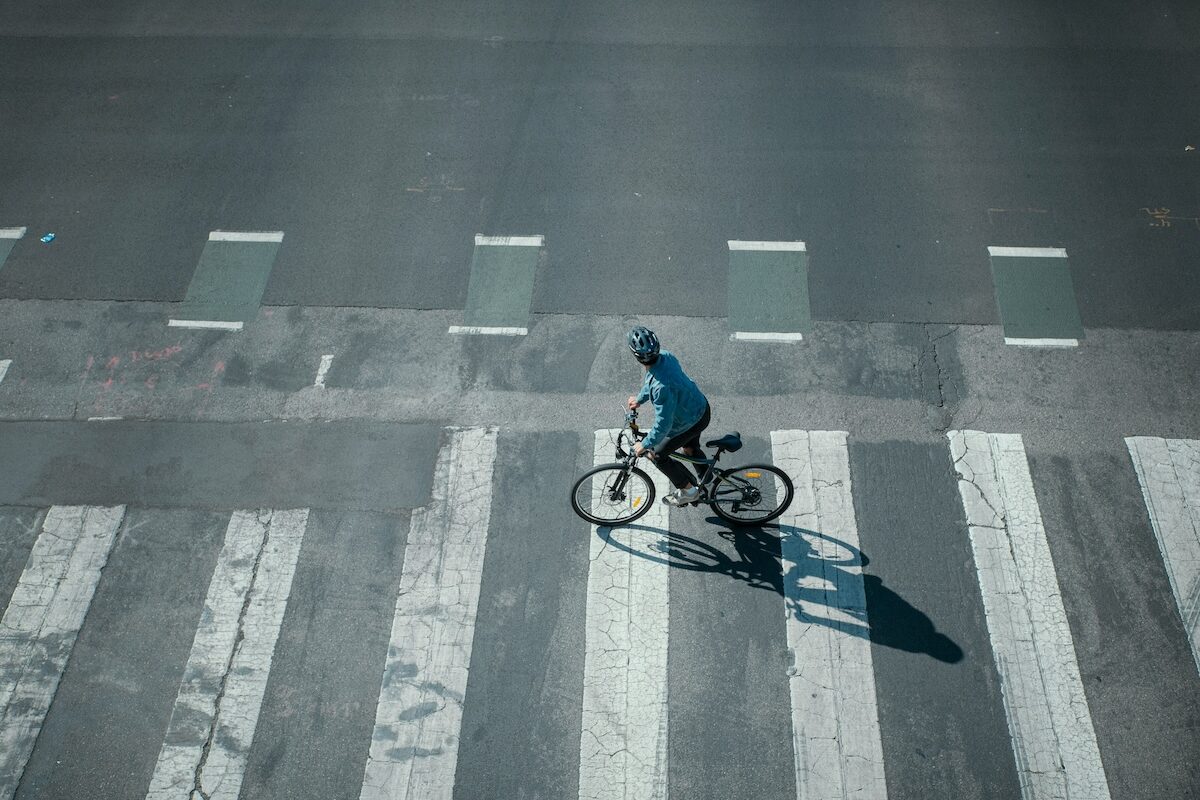
The failure of enforcement sends a signal to anyone on two wheels: the footpath is yours. Pedestrians be damned.
Walk down any footpath and it’s highly likely you’ll have an unrequested encounter: the whoosh of a bike passing within centimetres of your shoulder, or the sudden buzz of a motorised scooter or e-bike bearing down from behind. For many — parents with prams, people with disabilities — the footpath no longer feels safe. How did we get to this point, and why does it appear nothing’s being done?
Before we get to the law around bikes, let’s do a refresh on why footpaths were first constructed. The origin of the modern footpath goes back to Paris around 1780. The French called them trottoirs — from the verb ‘to trot’ — a name that speaks directly to the problem they were designed to solve. So, what was that problem?
Paris streets were unpaved and a free for all: pedestrians, traders, livestock, and horse-drawn carriages competing for the same muddy track. Horses were fast and indifferent to anyone on foot. Injuries and deaths were common. To sort this problem, Parisians raised stone kerbs separating pedestrians from the road — a simple idea the world gradually adopted through the 1800s. These trottoirs was created to protect people on foot from fast moving things. So, it’s ironic that more than two hundred years later we have the same problem — with bicycles and e-bikes rather than horses.
The law on this is clear. Legally, cyclists aged 12 and over are generally required to ride on the road or in a designated bike lane. If accompanied by an adult, children under 12 can ride on footpaths. It’s totally illegal for petrol-powered bikes, scooters, and most e-bikes to ‘hog’ these pedestrian owned spaces.
Numerous forces have converged to create the chaos that pedestrians face. The explosion of food delivery apps (Uber Eats, DoorDash, etc) is just one, but it’s a significant problem. Under pressure to deliver orders, many riders choose footpaths over roads. Their logic seems to be that the risk of being hit by a car is more likely than the risk of a fine or abuse from a pedestrian. As if they care about the latter.
Where are the police here? The law isn’t ambiguous. NSW Police have authority to fine cyclists riding on footpaths. Yet enforcement seems rare.
Perhaps this is the police view: resources are limited and priorities lay elsewhere. But when riders see that there’s no consequence for footpath cycling, many will simply intrude. I’ve come within centimetres of being knocked over — no warning bell, no apology. Just the unexpected rush of something passing where it had no right to be. It’s frightening.
While the rules are clear on paper, it’s a different story on the footpaths, at least in my experience in Sydney.
The incident that stays with me involved my granddaughter, who was two years old at the time. We were in the mall at Bondi Junction — a pedestrian space, where families shop and children walk freely — when a bike came through at top speed. She was nearly run over. The rider didn’t stop. It was the terrifying realisation of how close it had come.
If it can happen in the middle of a mall to a toddler, it can happen anywhere. And it will keep happening until someone in authority decides that pedestrians — including the smallest and most vulnerable among us — deserve to feel safe in the spaces built for them.
The footpath has always been a space that belonged to pedestrians. That’s worth defending — not out of hostility to cyclists, but out of a commitment to the idea that users of that space deserve protection. Right now, they’re not getting it. Until governments, police, and the platforms that profit from gig economy riders decide that pedestrians matter too, the chaos on our footpaths will get worse. The next two-year-old in a shopping mall might not be as lucky.
Where are the authorities? Aren’t our taxes used to keep us safe? Isn’t this part of law and order, a lack of which often topples governments? If the police are overworked and under resourced to protect us, isn’t this a question for the Ministers of Police in each state? Or is this another case of Yes, Minister?




Maureen, I understand your concern and I believe governments made an error in allowing “e” anything on footpaths that are capable of anything over a fast walk (6kph, being generous).
As a very recently retired police officer, the legislation is the problem that is hindering enforcement.
If a council determines an area is to have no bikes/scooters etc, the council enforces it, police have great difficulty as they have to use council processes/paperwork and obtain statements etc for the council, a police officer can make a statement and hand all the evidence over to the council to pursue- best of luck with that one – it typically goes no where. So Police typically don’t enforce council bylaws even though the legislation may make them an authorised person under the Act.
State Legislation is where Police are mainly active in, BUT, the legislation is written in such a way is is next to impossible to enforce.
For example, a rider can’t exceed 10kph on a footpath. How does the Police Officer prove that in court? To prove speed in court Police need to produce a certificate proving the device used, is an approved device in the regulations, that every 12 months it is checked in a laboratory and at the start of and end of use of the device, the officer did certain tests to confirm the proper operation of the device. Then they obviously have be carrying the device with them, ensuring when using it there was clear line of sight and no one else or any other device could not possibly be in the view and thus recorded the wrong individual.
So you see why Police don’t/rarely enforce this unless the breach is at the extreme end and other factors can lead to the proof.
To my mind the legislation should simply say a “e” something cannot exceed “some wattage” and any vehicle that has these values obscured, removed, altered, apparently altered is deemed to be non-compliant.
In the definitions section -: Wattage is determined by battery voltage x regulator maximum output.
That way police can easily and quickly determine if an “e’ vehicle is legal and take positive action. A wattage of 150 should be ample, maybe 200 to assist on a hill but still governed speed to 6kph.
With the huge growth of e-mobility devices, governments have not bothered to keep up. And so people use pavements largely because of aggression from some motorists. Perhaps we should allocate one lane of roadways to which is clearly a new transport type and needs to be catered for.
A couple of comments
– the age for riding on footpaths – is 12 in Vic, 16 in NSW and there is no age limit in other states/territories across Aust.
Roads were built for bikes – and then taken over by cars – and bikes were squeezed into not belonging on either footpaths or raods.
That is not an excuse, but reality. Australian’s stopped riding because it was unsafe, and riding was the domain of the strong and fearless. Now more people want to ride we are realising we’ve dropped the ball.
Roads are a challenge because cars are the most dangerous thing on the road (for riders and walkers), shared paths dont work, because speed differential between riders and walkers doesnt work. So we need more dedicated bike infra, but that is a highly contentious issue for political reasons, as with limited space, it will often mean less car parks or a reduced car lanes.
The infrastructure hasn’t kept up with demand, there should be more separated walking and bike infra, but something has to give for that to happen.
Last observation – if you almost get hit by a car, most people blame the individual car driver, if you almost get hit be a bike, most people blame bike riders as a collective.