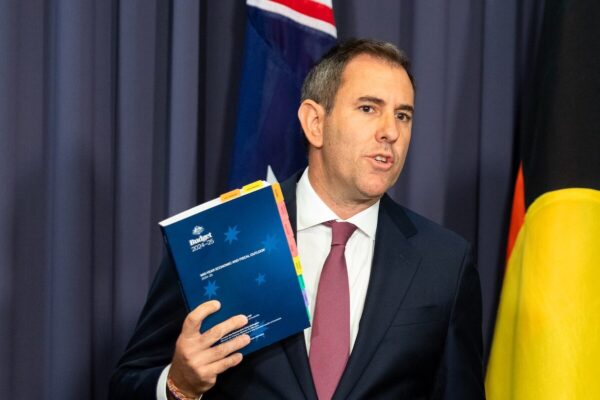
Today’s budget update will project a deficit of $36.8 billion for this financial year, which is $5.4 billion better than forecast in the Pre-election Economic and Fiscal Outlook (PEFO) issued before the May election.
The update projects deficits that are slightly better in every year over the forward estimates than forecast at the election. Cumulatively, the deficit is $8.4 billion better than over the four years to 2028-29 than PEFO.
The government earlier revealed the update will contain $20 billion in savings.
Despite critics attacking the level of federal spending, the government says it is exercising spending restraint, ensuring net policy decisions are positive for the first time in eight years, with net decisions improving the bottom line by $2.2 billion.
Treasurer Jim Chalmers says the update will be “all about responsible economic management”.
“We’re not only improving the bottom line but also ensuring that essential services, like support for veterans, disaster recovery, and the aged pension, remain robust and responsive to community needs,” Chalmers said.
At the weekend Chalmers stressed the update was not a mini budget. “There’s not a lot of new stuff in there, But there’s a lot of hard yards to make room for our commitments and the big pressures on the budget which are intensifying rather than easing,” he told Sky News.
The government has avoided some extra spending by announcing it won’t extend the energy rebate that has been easing household power bills. That expires at end of this month.
But it revealed at the weekend a massive blowout in the cost of its subsidy for installing batteries. The subsidy was earlier estimated to cost $2.3 billion up to 2030. But the projected cost was headed to $14 billion, because people were disproportionately buying large batteries. The government responded with extra funding and changes to the scheme, which is now set to cost $7.2 billion over four years.
Independent economist Chris Richardson said the budget update will have some “revenue rainbows”.
Richardson said revenues were up because of higher than expected inflation, key export prices holding up (and gold prices soaring), and AI-fuelled sharemarkets boosting the tax take on super and on capital gains.
Deloitte Access Economics Partner Stephen Smith said: “Escalating spending pressures and an outdated tax system are expected to mean budget deficits as far as the eye can see.
“It is imperative that greater attention be paid to government expenditure, particularly through the systematic adoption of program and policy evaluation to amend, continue, or discard programs based on their efficacy. In addition, a careful root and branch review of expenditure responsibilities between the Commonwealth and the states and territories is long overdue.
“Critically, a focus on well-considered tax reform that turns deficits into surpluses, boosts productivity and growth, and enhances equity in our tax system is needed.”
Michelle Grattan, Professorial Fellow, University of Canberra
This article is republished from The Conversation under a Creative Commons license. Read the original article.