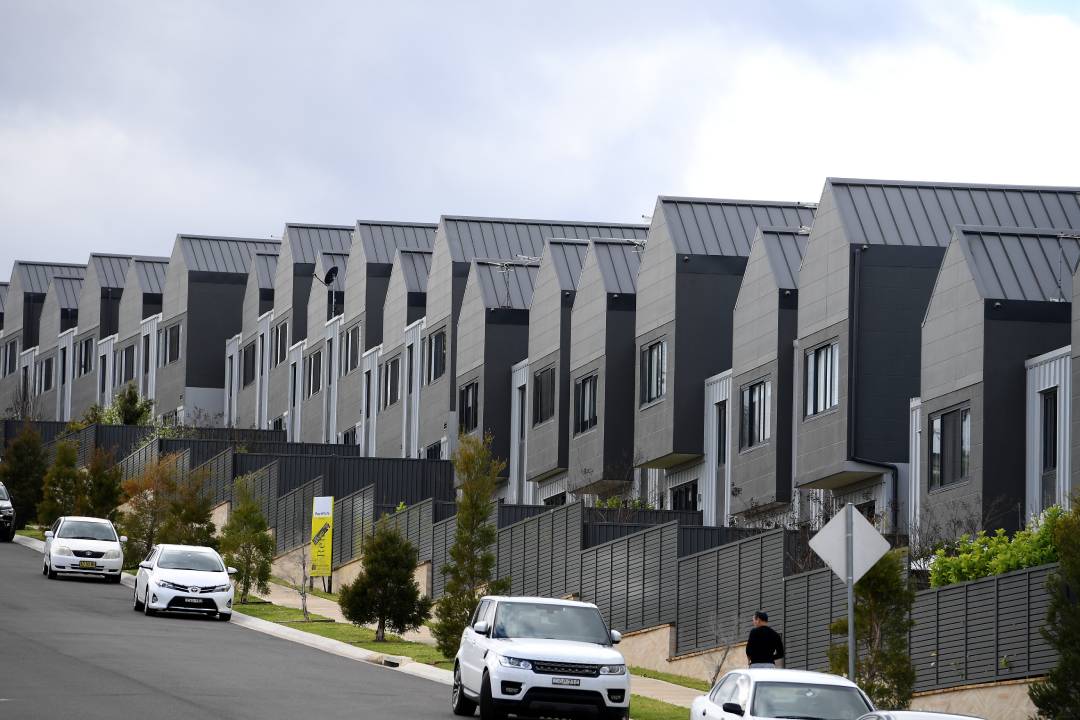
Sydney’s Liverpool is at the epicentre of a national house price crash that could end up being a lot worse than what economists are predicting. And given that the Reserve Bank is driven by economists who try to guess where the economy is going, we really need these well-trained people to guess right.
Yesterday the RBA followed the script that economists like me accepted was definitely on the cards because firstly, inflation has persisted above the RBA’s 2-3 percent band, both in headline and underlying terms, and secondly, the central bank has been prepping us to expect a rate rise.
Even if an economist thought this fourth rate rise and the other two that some are tipping are likely to come and will cause a house price crash and recession, the fact is that economists not only guess the economy, their bigger job is to guess what the RBA will do.
The economist who might have guessed the economy and what the RBA should do is Judo Bank’s chief economic adviser Warren Hogan, who was warning in 2025 when the RBA was cutting rates that they would need to reverse course. That said, he was helped by President Donald Trump, whose bombing of Iran has sent oil prices sky high, taking inflation with them.
Treasurer Chalmers also helped inflation by not cutting back spending, failing to control blow-outs such as the NDIS program and too many tax cuts.
The combined effects of big spending governments (both federal and state), plus rising interest rates meeting higher petrol prices and the Budget tax changes that have undermined the foundations of the housing sector, have left us in a tricky economic situation, and a smart RBA should not be thinking yesterday’s rate rise needs to be followed up by another on Cup Day on November 3.
The big bank needs to watch the incoming data drops and today’s CPI for the month of August will be an important first start in this survey of stats on what the economy is doing. However, a monthly number lacks credibility and so the September quarter figure out on October 28 will be a big one influencing what happens to rates on Cup Day.
I also think the jobs report on October 15 will be another important number and interest rate worriers might want to see the jobless rate go from August’s 4.6% to something higher. The RBA wants to see its rate rises biting the economy and according to Martin North of Digital Finance Analytics, they’re really getting their teeth into places like Sydney’s Liverpool and the Central Coast of New South Wales.
The Daily Telegraph talked to Martin North and this is what the statistics-watching business founder has detected about the housing sector:
- Two million households are struggling to make their home loan repayments.
- Liverpool in Sydney’s south-west is the worst-affected.
- Gosford on the Central Coast has the highest incidence of forced sales because of rate rises.
- The highest stress areas with serious cashflow problems are in high-growth corridors around our major cities.
- North says those who took up the Albanese Government’s 5% deposit scheme were “the most exposed.”
North sees a disaster brewing.
“I expect forced sales, defaults and property price falls to accelerate,” he told The Daily Telegraph.
“No region of the country is now avoiding the impacts.”
On latest count, the Tele reports that Sydney prices are down 8% this year, while Melbourne properties are down 7%, Brisbane’s are off 4% and Adelaide 3%. Perth prices were down 2% in the June quarter alone.
Following the 0.25% lift in the cash rate of interest by the RBA, a $500,000 mortgage goes up by $320 a month, making the total monthly slug $3,146 a month.
As I’ve argued, watching the data drops on inflation and unemployment is important, but so is the net wealth effect of falling house prices. But as an economist, I know my colleagues cannot confidently know how to measure this big negative for the economy.
This and an end to the Iran war could be the best hopes for stopping this RBA reign of terror on households with mortgages!
By the way, I did like this from AMP’s chief economist, Shane Oliver: “Our base case is that rates have probably peaked as the RBA has likely now done enough to weaken demand sufficiently to push inflation back to target by the end of next year.”
Let’s hope he is right.

This ‘Government’……..our living costs have increased and our Asset values reduced!
Peter, I don’t think Shane Oliver gets out enough, I live in a regional town where for some reason, all the most expensive high-end restaurants seem to be full every night and everyone else is struggling. The van parks, after a slow start to the season are chocka with big new vans, and $150K tow-vehicles. It appears the older generation with paid off empty nests, millions in super, fully franked dividend stocks and eligible-pensioner-cheap-haircuts are spreading their lolly around like there is no tomorrow. I don’t begrudge them their wealth, they worked for it and they rode the property boom of the last 40 years, but there’s a big cohort of Aussies on the bones of their arses living week to week on the smell of an oily rag. I don’t think a 0.25% rate cut is going to get inflation down, I think it might take 2.0% at least. Not that a 2.0% rate increase will bother the cheap haircut brigade.
The correct interest rate rise prices impact question is not “how much will a current mortgage repayment go up?” but rather, “how much does that rate rise reduce what someone on a particular income can now afford to borrow to purchase a property?”
The answer to the second question directly answers your article Headline in the affirmative.
Per Canstar, the average owner occupier mortgage taken out since January 2026 is $733,000.
If you had a 10% deposit, then the purchase price for the average mortgage would have been $814,450. (ie) $733,000 loan + $81,450 deposit = $814,450.
The RBA has increased interest rates by 1% since January 2026.
If $733,000 was the maximum loan you could borrow based on your annual income, then your repayments on a 30 year loan at the January 2026 average interest rate of 5.5% would have been $50,000 pa.
Since the RBA’s 1% rate rises, the maximum loan $50,000 pa loan repayments will fund is only $650,000.
So the price you can afford to pay to buy a home after the RBA’s cumulative 1% rate rises is now only $731,450. (ie) $650,000 loan + $81,450 deposit = $731,450.
This is a 10% price drop due to interest rate rises alone.
the problem is that the board is filled witheconomist
the board needs people with up to date numbers like the heads of Bunnings, Meriton, JB hifi etc