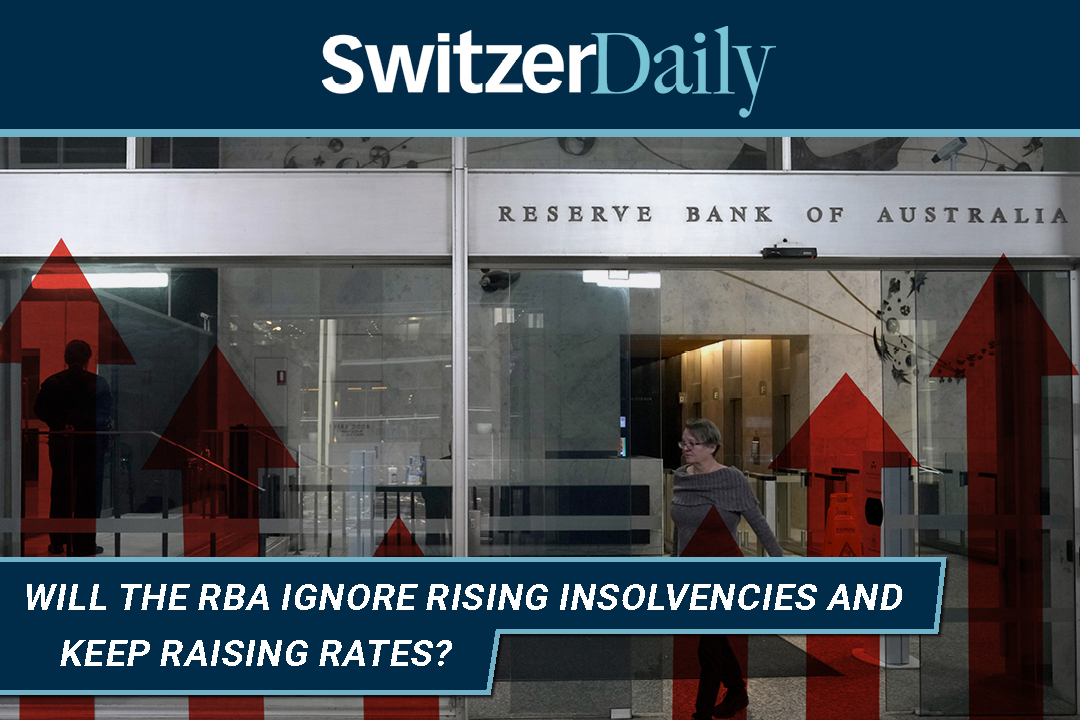
Here’s a drama that the new RBA Governor Michelle Bullock will have to consider when it comes to next week’s interest rate decision and the ones beyond it. It’s linked to an often-ignored statistic on an important subject called insolvencies.
Evidence is mounting that the past 12 rate rises are now starting to squeeze the economy and the tricky question for the new Guv must be: “Is this the start of something really bad?”
Of course, the next related question is: “Could this be the start of a recession?” This is the subject the RBA can never ignore because of its stated aim, which is as follows: “The Reserve Bank conducts monetary policy to achieve its goals of price stability, full employment, and the economic prosperity and welfare of the Australian people. It does this by targeting inflation between 2-3%, on average, over time.”
Today The Australian warns that corporate insolvencies surged by 62% in the year to June. If the RBA engineers a recession by accident, the numbers could soar higher.
That said, these numbers need to be put into historical context. I’ll list these so you can work out how worried we should be:
- For 2021-22, ASIC says the number of Australian companies that fell into administration, liquidation or receivership was 4,912.
- For 2022-23, that number is 7,943.
- This is the highest number of failures since 2018-19!
But these new bigger numbers look more worrying because during the Covid pandemic, “the Morrison government to protect vulnerable businesses from the economic shock of the pandemic,” put temporary measures in place to reduce the chances of businesses folding, The Australian reminds us.
So, despite the threat of recession and lockdowns, the
number of insolvencies went as low as 4,235.
But business is now back in the real world, coping with 12 interest rate rises, inflation that topped out at 7.8%,
workers insisting to work at home and other new age threats to profits, so it makes perfect sense that insolvencies are on the rise.
The big canary in the coalmine for bankruptcies and the possible threat of a recession is the building industry. The news isn’t great, with ASIC figures showing insolvencies there hit 2211 in 2022-23 — that’s a 72% jump year on year.
“The lion’s share of building collapses occurred in NSW, with 981 insolvencies, followed by Victoria with 619,” The Australianrevealed. “The ASIC data, released on Wednesday, showed overall NSW had 3,283 companies enter external administration for the first time in the 2023 financial year, up 72 per cent on the previous 12 months, with Victoria in second place at 2142 insolvencies, up 64 per cent.”
Building industry insiders say fixed price contracts, facing in some cases a 30% hike in building costs, have sent many players in the sector to the wall.
The big hope is that this insolvency problem is more specific to the construction industry, where Phil Dwyer, president of the Builders Collective of Australia, see the collapses as the worst in 40 years.
That would take us to the 1980s, which ended in the worst recession in recent memory when unemployment went over 10%. The jobless rate is now 3.5%, and it’s the RBA’s job to make sure that it doesn’t go anywhere near 5%, let alone 10%. That’s why Ms Bullock needs to be careful with her interest rate settings.
CBA’s CEO Matt Comyn recently pointed out that the cost pressure on households would intensify in coming months as the full impact of rate rises hits consumers.
On the subject of rates and the new RBA boss, Comyn told ABC radio something many home loan borrowers would be happy to hear: “We see one more rate hike – hopefully no more than that – and I think that will probably set a slightly different set of conditions for Michelle.”
My view is that the RBA has done enough. It’s time to watch the data over the next few months – numbers like these insolvencies, retail sales and indicators that tell us about whether we could end up in recession.
Dr Phil Lowe will be remembered for his interest rate rises to kill inflation, while Michelle Bullock might become known for the rate cuts that killed or prevented a recession!
Let’s hope so.