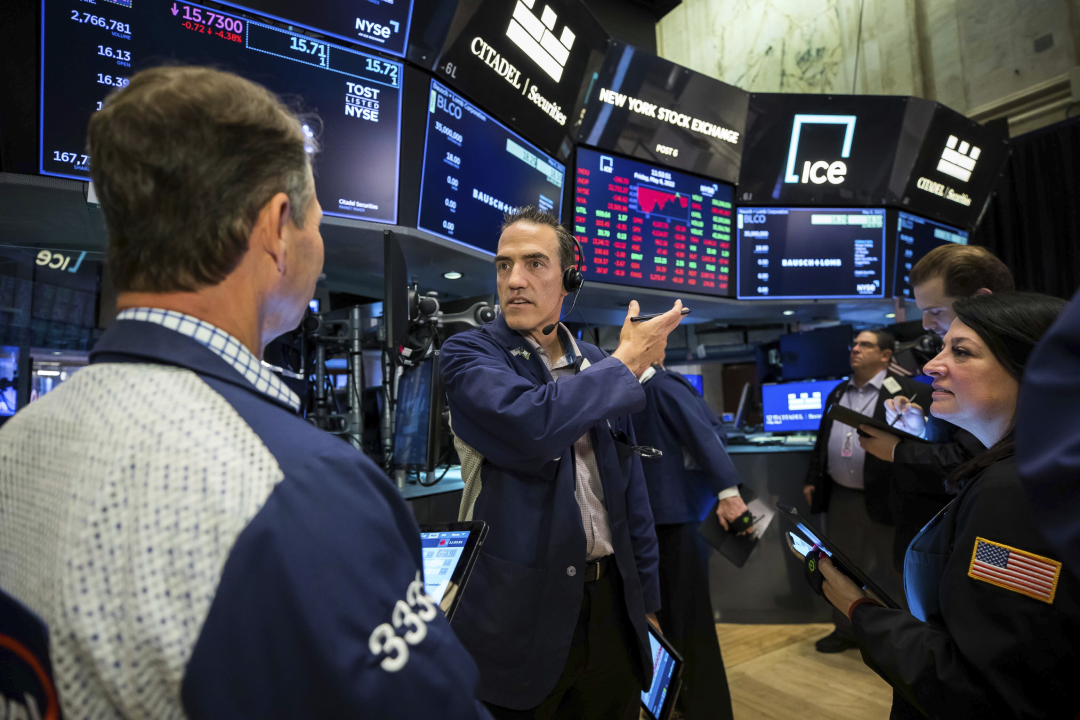
The count is still underway in the US midterm elections. But as ballots are tallied, investors are waiting to see if the longest-running tradition in markets plays itself out for a 20th consecutive time.
Since 1950, the S&P 500’s price has been higher six and 12 months after every one of them: 19 out of 19.
The midterms fall halfway through a president’s four-year term. On this week’s Switzer Show, Michael Gable, Managing Director of Fairmont Equities, was looking at the Nasdaq Composite’s chart when he told host Paul Rickard there was “quite a bit of panic selling last Friday in the US”.
“Historically, when the midterm elections are over, the US market has generally done really well for … quite a few months after that,” he said. “So … potentially, we are getting a bit of a wash out there.”
The S&P 500 fell 1.8% on Friday 30 October, US time.
What happened after the last 19 midterms?
We took the S&P 500’s close on every midterm election day from 1950 to 2022, 19 elections in all, and compared it with the close three, six and 12 months later. Where the later date was not a trading day, we used the last close before it.
The market did not trade on election day in 1950, 1954, 1958, 1962 or 1966, so for those five we used the close on the Monday before the vote.
These are price returns. They leave out dividends.
The S&P 500 launched in 1957. The figures for the 1950 and 1954 elections come from S&P’s earlier composite index, which the same price series carries back.
Three months after election day, the S&P 500 was higher 17 times out of 19. The two falls came after the 2002 election (down 7.8%) and the 2018 election (down 0.9%).
Six and 12 months after, it was higher all 19 times. The smallest 12-month gain was 1.1%, in the year after the 1986 election, a period that took in the index’s 20.5% fall on 19 October 1987. The largest was 33.2%, after the 1954 election.
| After election day | S&P 500 average | S&P 500 median | Times higher |
|---|---|---|---|
| 3 months | 7.7% | 7.6% | 17 of 19 |
| 6 months | 14.1% | 16.9% | 19 of 19 |
| 12 months | 15.1% | 14.5% | 19 of 19 |
And the All Ords?
The daily All Ordinaries series we used starts in August 1984, so it covers 10 midterms, from 1986 to 2022. We used the ASX close on the same calendar date as the US election, which comes before polls open in most of the US.
The All Ords was higher three months later in eight of the 10, with an average price gain of 3.5% and a median of 3.4%. After six months it was higher nine times, with an average of 9.7% and a median of 6.3%.
After 12 months it was higher seven times, with an average of 6.9% and a median of 7.8%. It was lower 12 months after the 1986 election (down 6.6%), the 2010 election (down 10.9%) and the 2014 election (down 3.7%).
The nerves
AMP Chief Economist Shane Oliver told the show he was “feeling a little bit nervous about things given inflation, given the midterms”. He said Donald Trump “will have the political constraints removed” once the vote is out of the way.
He put the midterms alongside the rise in interest rates and bond yields among the “things that make me nervous about markets”.
He said he still struggled to see a recession in the US and therefore a big slump in profits, “and unless you could see those things, then history tells us shares usually go higher”.
Peter Switzer, who joined that segment, said “we have to see what happens after the midterms and how Donald Trump approaches Iran”.
Gable said the Russell 2000, “the small cap index in the US, looks really interesting here”.
“I actually recommended last week for my clients to buy an ETF in the Russell 2000,” he said.
The caveat
Nineteen elections is a small sample, and past returns are no guide to what follows this one. Across those 19, the S&P 500’s 12-month price return ranged from 1.1% to 33.2%. The All Ords was lower 12 months after three of its 10.
This article does not take into account the investment objectives, financial situation or particular needs of any individual. It does not constitute formal advice. Consider the appropriateness of the information in regards to your circumstances. Before acting on anything we discuss, we strongly recommend you seek the appropriate professional advice.