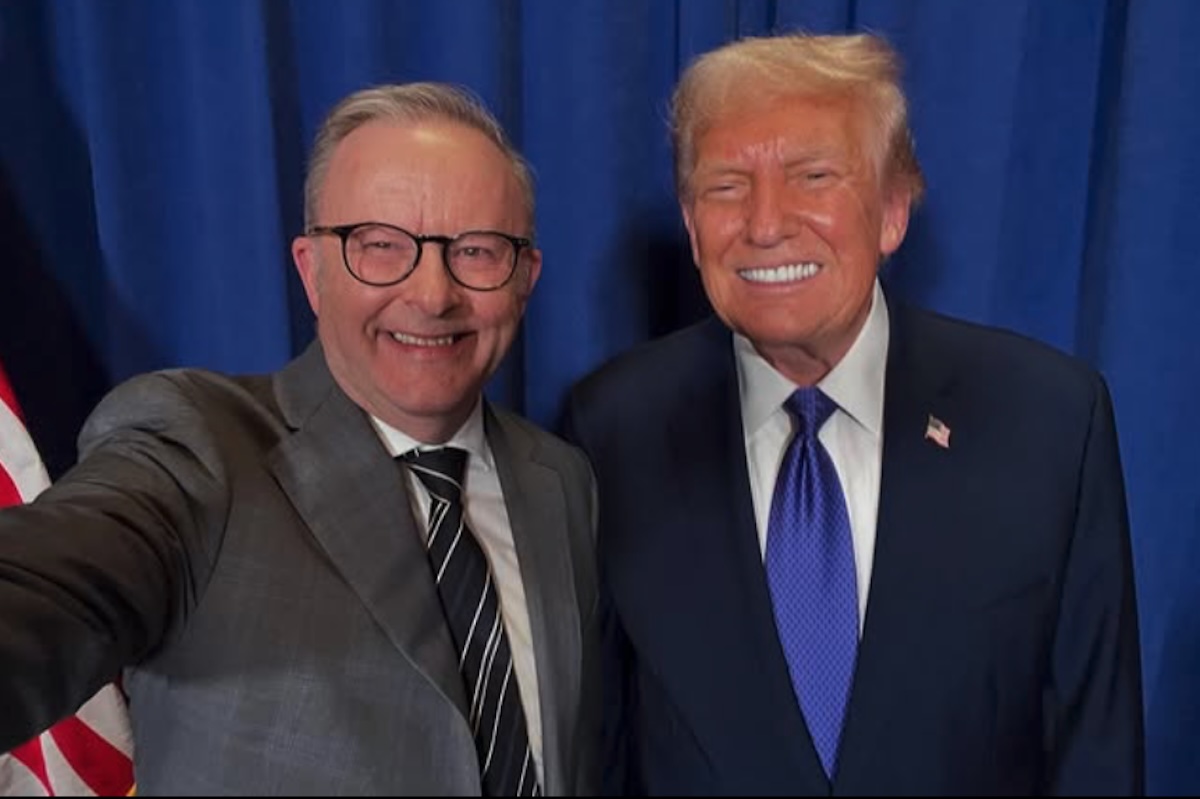
Anthony Albanese has seemingly again received the brush off, after months of diplomatic effort to secure a bilateral meeting with Donald Trump on the sidelines of the United Nations leaders’ week in New York.
The prime minister was not on the list of leaders, announced by the White House, with whom the president has bilaterals during his brief time in New York, where he addresses the UN General Assembly.
The Australians say, variously, a meeting will occur soon, or, no matter if it doesn’t happen (sub-text: an encounter with Trump is always a potential hazard anyway).
Some in the Australian camp have not written off the possibility of a meeting time still emerging this week. For what it’s worth, Acting Prime Minister Richard Marles declares a meeting will be “at some point in the near future”.
Nobody can predict Trump or his chaotic White House. But as things stand, the first Albanese-Trump face-to-face encounter unfortunately remains a matter of outstanding business.
The Australian PM does need to establish a personal relationship with Trump (and a handshake at a very large reception, if that happens, is no substitute).
While the government insists that on the important fronts, including AUKUS and tariffs, things are okay between the US and Australia, Lowy Institute executive director, Michael Fullilove, has described the relationship as “presently quite thin”, given the lack of a meeting (and the fact that as yet no US ambassador has been appointed to Canberra).
Fullilove said ahead of the Albanese trip, “the main priority for Mr Albanese when he meets with President Trump will be to thicken up the relationship”.
After a planned meeting in Canada fell through, Australian government sources and the prime minister himself talked up the opportunity this UN week would present.
A likely meeting certainly seemed imminent when the president, in attacking ABC correspondent John Lyons last week, suggested he’d soon see Albanese. “Your leader is coming over to see me very soon. I’m going to tell him about you,” Trump said.
It’s anyone’s guess why Albanese is not on the announced New York schedule. It could be the president is too busy and the claims of other leaders are more pressing. Or that he is dismissing Albanese for the moment, for any one of a number of reasons.
Of course Trump is critical of Australia recognising Palestine, but then, so has the United Kingdom and that’s not affected Trump’s positive relationship with UK Prime Minister Keir Starmer. The Palestinian question is one of the major issues Albanese is pursuing this week. He told the Two State Solution Conference at the UN, “we must break this cycle of violence”.
Perhaps Trump doesn’t rate Australia highly enough to go out of his way to accord it any special respect, seeing it as just that useful country down under.
Whatever the diplomatic implication, another failed date night wouldn’t do Albanese any harm domestically. Australians are, for the most part, anti-Trump.
But that should not be the measure. What’s more relevant is that we are, strategically, in a highly uncertain region, elevating the importance of trying to understand where the US is at.
Reinforcing the point, Albanese has had two recent failures diplomatically. A proposed $500 million deal with Vanuatu fell over and, more significantly, the prime minister was unable to sign a much talked-up defence deal with Papua New Guinea. The government says it is confident the PNG agreement will be signed soon, but delay always opens the possibility of slippage and the Chinese are urging PNG not to sign it.
Three diplomatic misses in as many weeks? Not a good look.

Michelle Grattan, Professorial Fellow, University of Canberra
This article is republished from The Conversation under a Creative Commons license. Read the original article.