
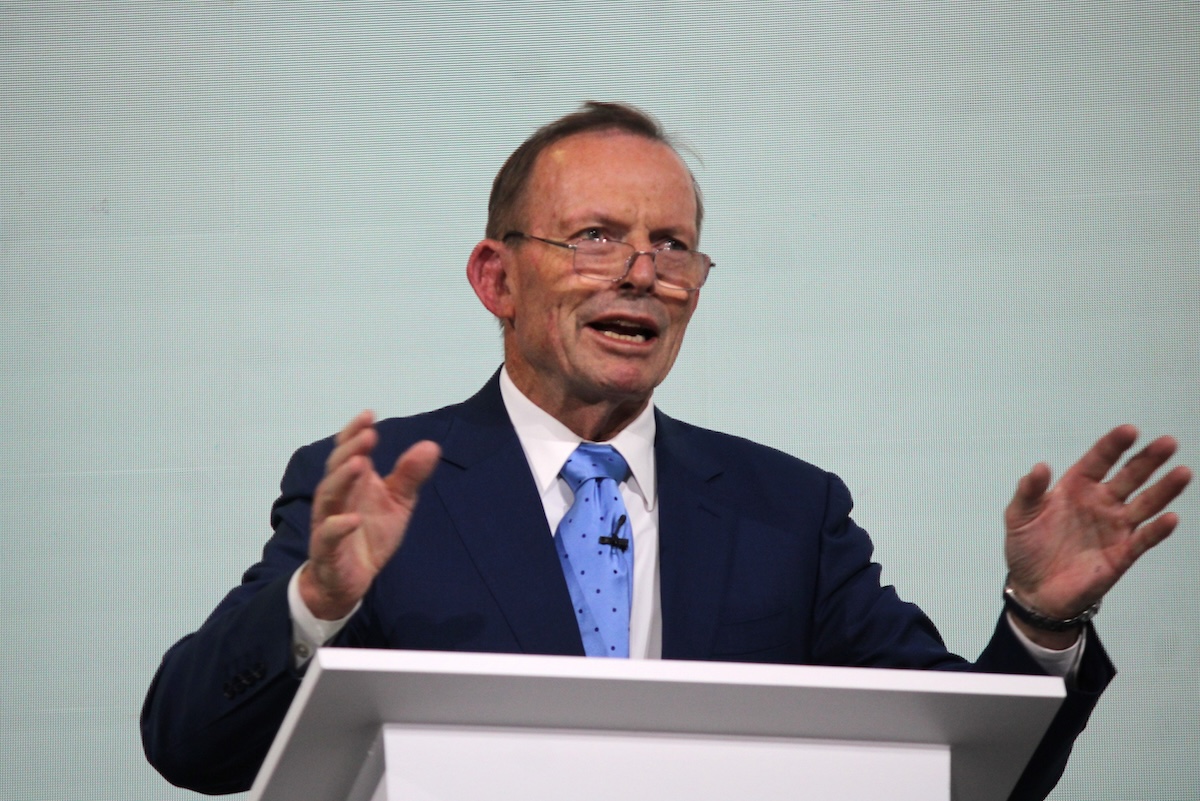
Former Prime Minister Tony Abbott has been writing on a platform called Substack about a range of issues. In this guest post, also published on the Former Prime Minister’s Substack, Tony Abbott discusses what Australia needs to do to avoid being ‘caught short’ by the next eventual fuel crisis we face as a nation.
The impact of Iran war is just the latest sign of the trouble we’re in. Australia might still be the world’s best place to live but we’re letting ourselves down big time and the escalating fuel crisis is yet another symptom of our decline.
No one should have been unprepared for the blocking of the Straits of Hormuz because the Iranian theocracy has been threatening precisely this for nearly five decades. And no country should have been more alive to this peril than Australia—given that we run on diesel and have lately had scarcely 30 days supply of liquid fuels onshore.
With declining local oil production and the closure of local refineries ongoing since 2012, we’ve been in breach of our treaty obligation to hold stocks onshore sufficient for 90 days. The Gillard government concluded, back then, that large scale domestic storage was unnecessary thanks to efficient global markets. Although this worried me as PM, I did not buck the official advice. For a country that uses more diesel per person than any other, this was always risky, but it surely became negligent once the pandemic highlighted the fragility of global supply chains in any serious crisis.
So here we are, scarcely four weeks into the Iran war: with about 10% of our servos wholly or partially out of fuel; with about 30% of farmers worried they lack the diesel or the fertiliser to sow or harvest their crops; with flights starting to be cancelled; with miners and transport facilities fearful for their ongoing operations; with no Australian-flagged fleet of tankers that could be tasked with a fuel rescue mission; with no naval ships capable of helping to break any Iranian blockade; and with no Australian air power yet despatched to the Middle East to help the US-Israel campaign against an apocalyptic theocracy, even though the Straits will never be secure while it lasts.
There are even proposals for leveraging our gas exports to bludgeon fuel supplies from East Asian refineries (even though it’s hardly their fault that the Straits are impassable) rather than resolving to make the most of our potential as a fossil fuel superpower and reliable source of energy security for the wider world.
Let there be no doubt about the reasons for our current predicament. Successive governments, especially the current one, have convinced themselves that an “unstoppable green energy transition” meant that access to fossil fuels was neither necessary nor desirable. All this despite the fact that fossil fuels are still responsible for 90% of our energy needs. Moreover, they are the essential feedstock for the fertilisers that keep alive the 8 billion people on this planet, not to mention the steel, cement, and plastic without which modern life is impossible.
Even if it’s mankind’s emissions that are slowly warming the planet (which I doubt), what’s the point of Australia’s manic drive to decarbonise? Of putting two of our three biggest exports at risk? Of driving our heavy industry offshore because of the increased costs inherent in wind and solar power? No one seems to remember that China’s annual increase in emissions exceeds our total.
So what should Australia do?
- First, rapidly build the onshore fuel storage needed so that we’re never again caught short.
- Second, resume oil and gas exploration and extraction so that, next time there’s trouble in the Persian Gulf, we can help rescue the world rather than plead for its help.
- Third, stop cannibalising conventional forces to pay for nuclear submarines a decade hence, so that we can again be a useful ally in all the world’s trouble spots.
- And fourth, make energy policy decisions based on a hard-headed assessment of our long-term national interest rather than on the conceit that Australian virtue signaling can somehow change the behaviour of other countries.
But there’s actually a deeper problem, a spiritual malaise, that’s sapping the morale and the ambition of what was once a country that set no limits on what it could achieve.
We think that our wealth has somehow made others poor, that the world’s problems are somehow the West’s fault, that settler societies are fundamentally unjust, and that mass migration, climate action, and concessions to identity politics are somehow needed as acts of atonement. Even though there’s no country on earth that’s been more generous to newcomers, that’s less racist and more colour-blind, and that (at least until the emissions obsession became more important than practical environmentalism) has made more efforts to improve air and water quality, and to tackle feral animals and noxious weeds.
The Bondi massacre was a wake up on social cohesion. The Iran war is a wake up call on national resilience. Dealing with both means recovering the self-belief needed for Australia to stay Australian.
You can subscribe to Tony Abbott’s Substack if you want to read more of his work.
