
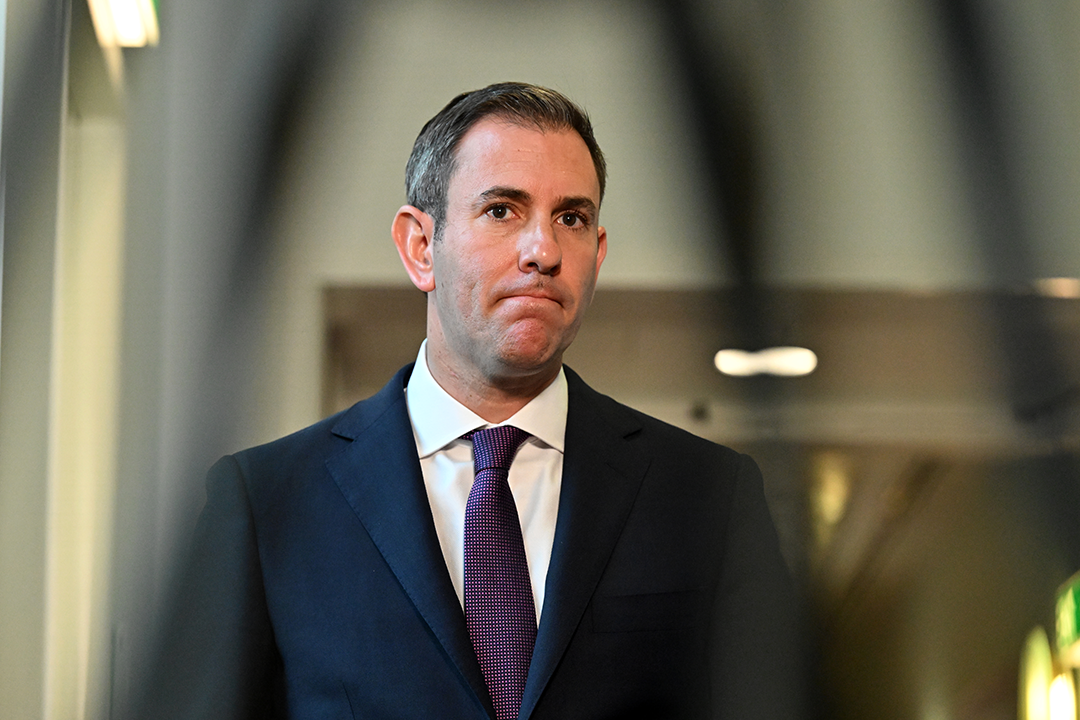
Another expert economist has ripped into Treasurer Jim Chalmers over the fact that we have a big budget deficit of over $22 billion and we’re set to have deficits for three years totalling $117 billion. That man is someone who did make a mistake on interest rates remaining low until 2024, namely Dr Phil Lowe, but that doesn’t make him wrong now.
Like a lot of economists, Lowe made a mistake forecasting that the cash rate could be around a low of 0.1% until 2024, but he did apologise in 2022. Even though I was critical of his call when he made it at the height of the Covid crisis and kept up my anti-Lowe view, I always knew three things about that mistake.
First, we were heading for a Coronavirus Great Depression when he made that prediction. Second, there was no vaccine in sight, and the world was being very selfish in its allocation of early Covid-killing solutions. Third, when vaccines showed up, plenty of leaders admitted that they had made bad decisions that only looked crook when you saw how quickly vaccines eventually showed up and lockdowns were ended.
In my recent podcast with former Qantas boss Alan Joyce, he made the same point in explaining why he made some decisions that looked terrible and selfish when he made them. There was one in particular that proved very costly for Qantas. The airline was ordered to pay a record-breaking penalty of $90 million for its “ruthless” decision to illegally sack more than 1800 workers. Justice Michael Lee cited the “sheer scale of the contraventions” of workers’ rights, but Joyce now says no one in management expected the crisis to end so quickly. (You can see that interview based on his book, Riding the Jet Stream, at https://www.youtube.com/watch?v=Ioyp8DI0ARI)
Back to Dr Phil Lowe and he isn’t the first economist to make a bad call. I’ve made them, and happily not many, but as someone who has been commenting on the economy since the mid-1980s, I’ve seen some great calls and some lousy ones from our top number crunchers, which include other RBA bosses and Treasury Secretaries.
One big mistake doesn’t negate the things you have got right, as abc.net.au points out.
On Lowe, the ABC’s Gareth Hutchens wrote: “He saw the unemployment rate fall to its lowest level in 50 years without a wages explosion, a phenomenon that’s still not completely understood.” However, we only recall he said rates wouldn’t rise until 2024 but changed course to lift rates by 4 percentage points over the next 13 months, starting in May 2022.
By the way, he was advised by a board of economists and smart business and industry people who didn’t tell him to change his call. And in fact, his successor, Michele Bullock, has shown how hard rate-setting is as she cut rates three times in 2025 but then has increased them four times this year.
Bullock has got it wrong without a pandemic challenge, though she has had to deal with an unusual Treasurer in Jim Chalmers. And Dr Lowe’s take on Jim underlines his problematic approach to budgeting and government spending.
In an exclusive interview with the chief economist of the Institute of Public Affairs, Adam Creighton, Lowe explained what is disappointing about Chalmers’ work, which has slowed the economy and has hurt living standards via high inflation and interest rates.
Based on his wide experience in economics and public policy, this is what he told Creighton: “Now we find ourselves running sizable budget deficits at a time where we’re at full employment and commodity prices are very high. We should be running sizable surpluses.”
Here are his main criticisms of Chalmers’ performance:
- Government spending has increased demand and inflation.
- Expanding the economy is less important, running second to redistributing income, which I say targets non-Labor voters in favour of Labor and potential Labor voters.
- The policies are designed to also redistribute wealth.
- Balancing the budget needs to be a priority over time.
- Reverse the excessive regulation that has escalated.
- Get energy prices down.
- Reduce income taxes and effectively raise the GST to give us tax breaks.
- Slow down population growth, which means less immigration.
- Assist the construction industry to build more homes.
While Dr Lowe might have made a bad call on rates, he had more excuses for that mistake than Dr Chalmers. And it should be noted, as Creighton pointed out, that Dr Lowe holds a PhD in economics from the Massachusetts Institute of Technology and served as Deputy Governor of the RBA from 2012 to 2016 before becoming Governor.
Dr Jim Chalmers has a PhD in political science and international relations from the Australian National University and a first-class honours degree in public policy from Griffith University. I rest my case.
Peter, Good comments. Thank you.
Please stop calling Chalmers Dr Chalmers.
He has a degree which most of us educated people undertake in our retirements.
Nice to do eg a BA, rather than a technical degree eg Economics and Finance
Rates are not that high. Money must be priced correctly. If made too cheap, as happened during COVID and beyond, asset bubbles form and speculation runs rampant. We really are only in neutral territory so all those leveraged speculators out there need to get used to it. Work hard, save up and the borrow in a sensible manner if needed.
Maybe if the government targeted the likes or Murdoch / NewsCorp and other high profile companies that have paid zero tax in the last 10 years then govt might have slightly smaller deficits….instead the PAYG and small businesses do most of the heavy lifting.
Secondly if immigration is the scape goat for our inflationary woes then we have got a big reckoning coming. Who do you think mans the kitchens in pubs, restaurants, hotels. Who do you think picks the fruit or jumps on headers at harvests ? Who do you think wipes the bums of the aging population in nursing homes ? Dont see too many white faces doing these jobs ? Wake up , immigration is not the issue. And for that matter it was John Howard and Peter Costello who imported economic growth for their tenure by increasing immigration.