
Normal people can be alarmed at what economies and stock markets can throw at them. We have two wars going on right now and both may be over sooner than you think. Read on…
Two wars are rattling our economic and financial well-being. While both are looking like they’re escalating (as the old saying goes), it’s always coldest before the dawn. Of course, the hugely worrying war is the one in the Middle East. The other is at home, as we battle with the enemy called inflation!
The Iran war isn’t helping the battle against a rising Consumer Price Index (CPI), which is being pumped up by surging petrol prices that are clearly linked to the blocking of the Strait of Hormuz and its impact on oil prices. And all this is pushing interest rates higher and threatening a recession, which could be the solution for this inflation we had to have, given the fact that Treasurer Jim Chalmers and Reserve Bank Governor Michele Bullock haven’t covered themselves in glory in their dual roles of delivering price stability (otherwise known as inflation control) and low unemployment.
For years, I’ve been a commentator, not a journalist. My background is different as I taught Economics at the University of NSW. I don’t need to be friends with treasurers and RBA bosses. Journalists often need contacts, secret sources and friends in powerful places for scoops. But as a commentator, I can be more candid when these important leaders get it wrong.
Don’t get me wrong, I praise these leaders when they deserve it, as I did with Paul Keating and his reform agenda when he was treasurer. But I also always socked it to him when he was the boss of the RBA boss Bernie Fraser, when home loan interest rates went to 17% on average for the bulk of borrowers in the late 1980s. For most young borrowers, that was simply too hard a time.
In my early days of writing in major newspapers such as The Sun-Herald and The Australian, I was surprised how treasurers and RBA governors could clearly have made serious mistakes without any sign of an apology. And yet they continued to make strong predictions about our economic future and how their hard decisions would change all that.
In that context, I’ve also learnt that often when people are most scared about an economic threat or stock market crash, it’s close to the point when a turnaround happens.
If the Iranian leadership was more rational, they’d say that we can’t beat “the enemy” and we don’t want more Iranians killed. So, let’s give up on our nuclear goals, make peace with Trump and become a more cooperative global country. Remember, with Ukraine, the Russians want to take land. But in Iran, the main goal of the US and Israel, is to take away their nuclear ‘toys’.
And now for the local war at hand. Yesterday we saw two positives for fighting inflation — unemployment rose from 4.1% to 4.3% and full-time jobs lost out to part-time jobs. While it’s early days for these ‘positive’ anti-inflation signs, you have to remember that a real economic slowdown or recession might be needed to slay the inflation dragon.
This was the contention of chief economist Paul Bloxham at HSBC. If he’s right, that will be forever on the CVs of both Chalmers and Bullock. Luckily for them, future generations won’t read economic history books and serious newspaper pieces — Facebook, Instagram, Tik Tok and whatever other platforms tech nerds come up with, should see to that!
Today in the AFR, Lea Jurkovic reports that “Australia’s unemployment rate is forecast to climb further after hitting 4.3 per cent in February as the rising cost of living drove more people into the job market.”
Economics can be tricky for normal people because employment rose by a bigger-than- expected 49,000. But because more people went looking for work, the percentage for those out of work rose. Economists say the participation rate increased from 66.7 % to 66.9%.
When Australians saw interest rates soar in the 1980s, I was a teacher, I took on a bar job at the Paddington-Woollahra RSL on Saturday nights, and I had a small cleaning business, where I cleaned the Fairlight Instruments factory in Rushcutter’s Bay that combined piano keyboards with microprocessors for new age instruments that the likes of Stevie Wonder, Led Zeppelin, Peter Gabriel and Kate Bush bought and used.
It was an early sign that tech nerds were going to change life as we knew it. Jobseekers are seeing it now and will see more with AI. High interest rates and a slowing economy will make many employers look at AI to lower costs, which will add to the jobless numbers.
While part-time jobs rose by a big 79,000, 30,000 full-time ones were lost. And it will be the trend for full-time jobs that will be closely watched by the RBA, Treasury and economists as they try and ‘guess’ how many rate rises lie ahead and when they might start falling.
Clearly, an earlier-than-expected end to hostilities in the Middle East will be good for lower oil prices and inflation. So, let’s hope Trump finds a settlement solution with the Supreme Leader of Iran.
Importantly, overnight CNBC reports that “the leaders of the United Kingdom, France, Germany, Italy, the Netherlands and Japan expressed in a joint statement Thursday their ‘readiness to contribute to appropriate efforts to ensure safe passage through the Strait.’ That should be a plus for oil prices and even an end-of-war possibility.
Jurkovic quoted AMP economist My Bui, who said “[there] is not much news for the RBA with the February labour report, with the unemployment rate printing at exactly the Reserve Bank’s forecast and employment growth a bit stronger”.
While that might be true in isolation, you can’t entirely trust one month’s worth of data from the ABS on the job market. But our future story changes when you see all the forces that might help bring inflation down.
As this is an important day for our economic outlook and here’s why:
- The RBA has raised interest rates two months in a row and rate rises work on a lagged effect.
- The 50 cents a litre rise in petrol is akin to a two or three rate rise effect.
- More people are looking for jobs as employers are looking at AI to lower their wages bills and increase productivity.
- Treasurer Jim Chalmers is being pressured to produce a budget that will raise taxes and cut spending to reduce the deficit. This will rob the economy of demand and slow the economy down.
- Business and consumer confidence has been weakened by all the economic fallout from the war.
- Even if the Iran war ends sooner than we think, oil experts say the price of this critically important production input (along with natural gas) could remain elevated over the US$65 a barrel, which is the price it was before the war.
One final point needs to be dragged up out of history. In the early 1980s, when Ronald Reagan was the US President, the world entered into a global recession. Our then Treasurer John Howard opted for a responsible budget as the deficit had blown out under Prime Minister Malcolm Fraser.
His action of producing a responsible and restrictive budget, when the economy was shrinking because of the global recession and other local factors, meant that Mr Howard actually made the recession and deficit worse!
Recessions kill jobs, put more people on the dole and tax collections fall. Right now, Treasury and the RBA might be underestimating how slow the economy will be, so the May Budget could slow the economy down so much that we might see fewer rate rises than have been predicted and cuts could come sooner than most people think.
Bloxham told the AFR that a recession to beat down inflation could be coming, especially if the Iran war drags on, which might mean the RBA could be cutting rates by November this year.
By the way, the good news overnight was from CNBC that reported “the leaders of the United Kingdom, France, Germany, Italy, the Netherlands and Japan expressed in a joint statement Thursday their ‘readiness to contribute to appropriate efforts to ensure safe passage through the Strait’.”
Also, oil prices fell as Israeli Prime Minister Benjamin Netanyahu spoke to the media, saying that Israel was helping the U.S. open the Strait of Hormuz, according to wire reports. Netanyahu also said that Iran had lost the ability to enrich uranium and make ballistic missiles and that the war may end sooner than people think.
With so many curve balls affecting economies, you can see why treasurers and central bankers make mistakes. But it also teaches people like me that short-term scary developments should not over-spook you because in the longer term other important factors can offset the things that might be so worrying right now.
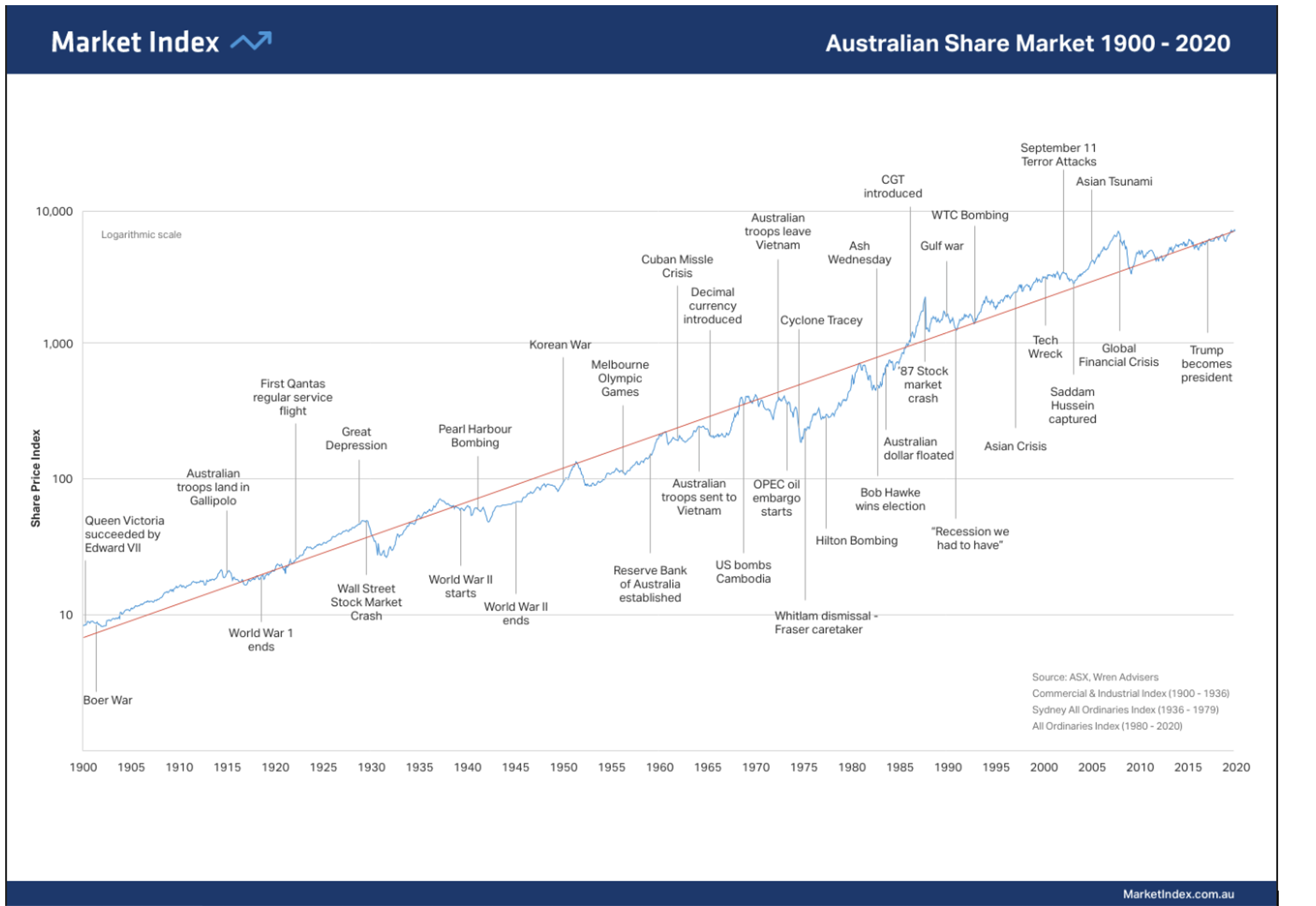
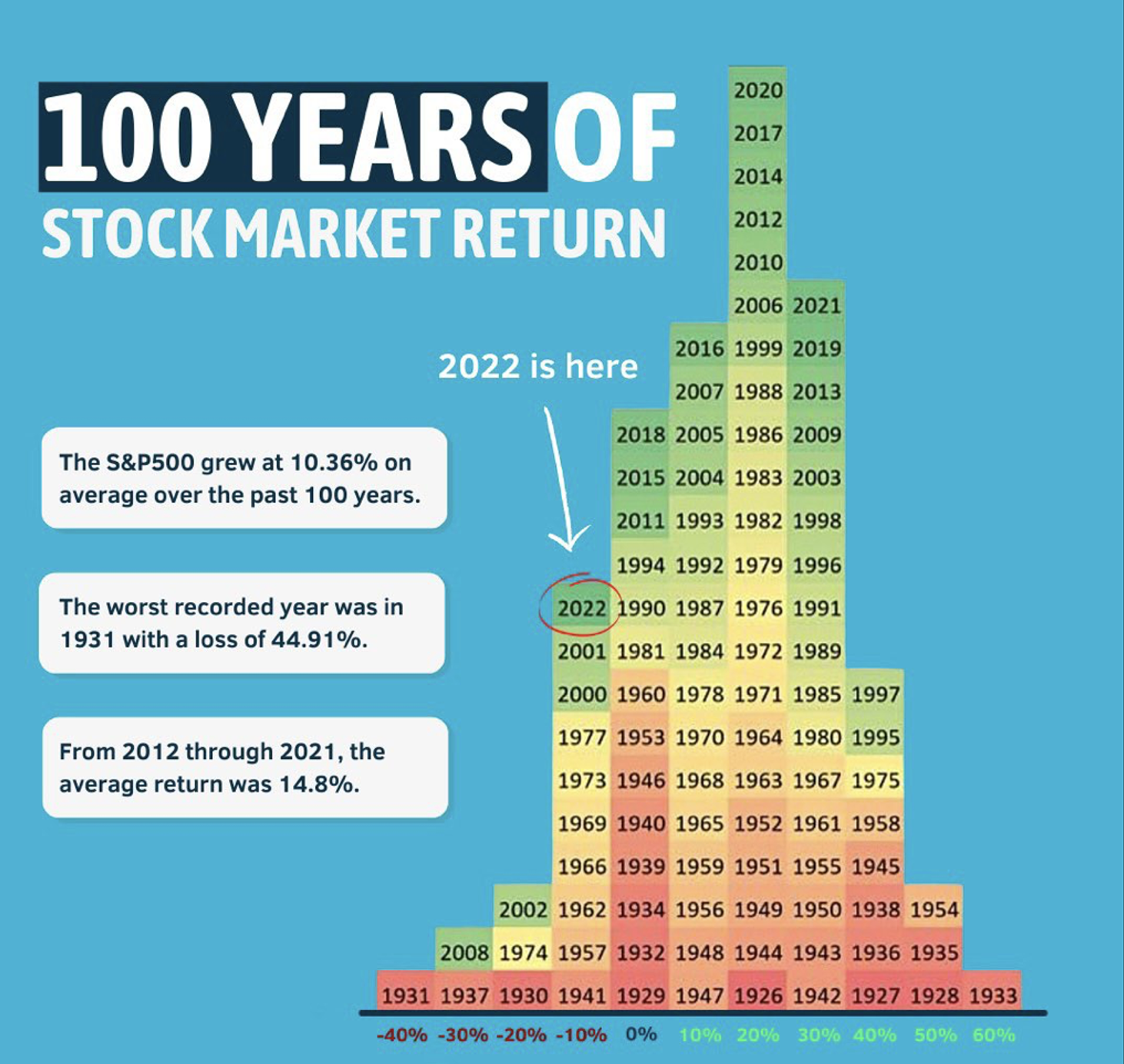
These two charts showing stock market returns, even with big, bad news events, should be contemplated if you’re too concerned.




Why should the US, which has an enormous stockpile of nuclear weapons, and Israel, which is known to have nuclear weapons but won’t declare them, dictate and deprive Iran of ‘its toy’? After all the addition of few nukes will NOT change the balance NOR it would invalidate the MAD doctrine. If Israel is keen to establish some decorum of peace in the ME it could get rid of its nuclear weapons and demand Iran and others follow suit. The proposition of ‘I have it BUT you cannot have it, in the hotly contested ME political theatre is a sure recipe for PERMANENT confrontations and violence. Israel does NOT have the right to deny others what they hold dear and sacred. That’s not politics, it’s pure and simple common sense to keep peace with neighbours. And if you can’t or won’t do it, then vacate the neighbourhood!
Another great article from Peter. He always puts things into perspective and maintains a positive outlook despite all the negative stuff filling our heads. I am reluctant to watch the evening news these days due to the lack of “good” news. They love anything negative and the headlines they often present are designed to grab attention and are an exaggeration of the real facts.
Keep up the good work Peter – you always calm my fears.
Thanks Peter, another goodie. Always enjoy your take on things, never knew you worked at Fairlight (even as a cleaner) that must have been cool to see them building those amazing machines that changed music forever. Nice anecdote.
What in hell is it with the anti-Iran comments in your article? “If the Iran Leadership was more rational…”, Do I have to remind you who actually started the war? And who’s actually winning it? Who’s controlling the theatre at the moment? It sure ain’t America or Israel.
Perhaps you want to add that Iran “cuts the heads off babies and chop women in half”, or, “they throw gays off buildings”, perhaps you believe a man can fly, truth, justice and the American way, I mean seriously.