A month before the November 28 Victorian election, a Newspoll has the Coalition surging to a 55-45 two-party lead over Labor. The Coalition would win a majority of lower house seats on these figures.
A federal YouGov poll gave Labor its lowest primary vote in any poll this term at just 24%, and Anthony Albanese’s net approval slid to a new record low of -30.
The Victorian election is on November 28. A Newspoll, conducted October 15-22 from a sample of 1,017, gave the Coalition 33% of the primary vote (up two since the late July Newspoll that was taken just before Ben Carroll replaced Jacinta Allan as Labor leader and premier).
Labor had 24% (down four), One Nation 20% (up one), the Greens 14% (up one) and all Others 9% (steady).
After preferences, the Coalition led Labor by 55-45, a three-point gain for the Coalition. The Coalition’s primary vote would ensure they make the final two in the vast majority of the 88 lower house seats, and they would win an outright majority on this poll, without needing One Nation’s support.
Carroll’s net approval was -28 (58% dissatisfied, 30% satisfied), an 18-point improvement on Allan. Liberal leader Jess Wilson’s was up two points to +10 (49% satisfied, 39% dissatisfied). Wilson led Carroll as preferred premier by 48-34 (51-32 against Allan previously).
On preferred government, 28% wanted a majority Coalition government, 28% a Coalition-One Nation government, 25% a Labor-Greens government and 19% a Labor majority government.
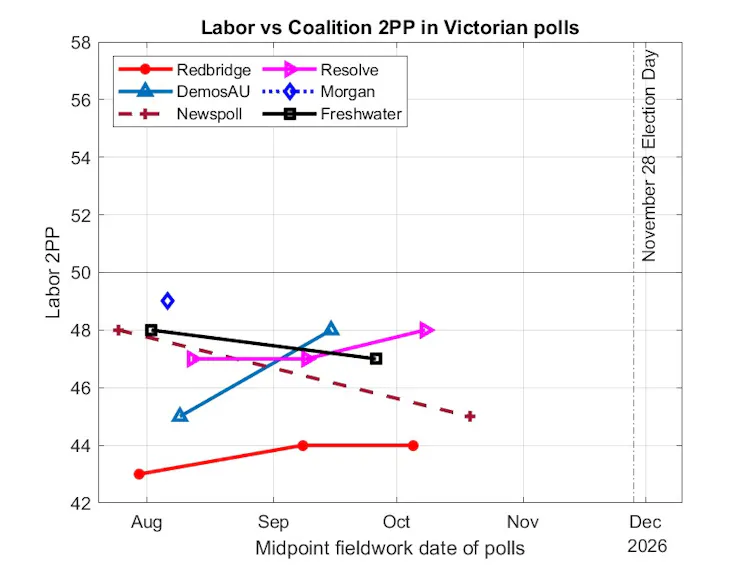
The Victorian poll graphs chart has been updated with Newspoll. Labor continues to trail by at least 52-48 in all recent Victorian polls and remains very likely to lose the election.
Victorian Morgan poll upper house analysis
All 40 Victorian upper house seats will be elected using proportional representation with preferences in eight five-member electorates.
Morgan has released analysis of the upper house from polls conducted between July and September from an overall sample of 2,845. It gave the Coalition 12 of the 40 upper house seats, Labor ten, the Greens eight and One Nation six, with four seats undecided.
This would give the left-wing parties of Labor and the Greens a combined 18 seats, tying the right-wing parties of the Coalition and One Nation. Like Morgan’s lower house analysis (46 seats to 42 for the left), this disagrees with other recent polls that would give the right a clear majority of upper house seats.
Federal YouGov poll
A national YouGov poll for News24, conducted October 13-20 from a sample of 1,542, gave One Nation 27% of the primary vote (down one since the early October YouGov poll), Labor 24% (down one), the Coalition 23% (up two), the Greens 14% (down one) and all Others 12% (up one). This is a record low for Labor in any poll this term.
By respondent preferences, Labor led One Nation by an unchanged 53-47. Labor and the Coalition were tied at 50-50, a two-point gain for the Coalition. It’s the first time in this poll that Labor has not led both the Coalition and One Nation.
Albanese’s net approval was down two points to a record low of -30 (62% dissatisfied, 32% satisfied). Angus Taylor’s net approval rose three points from a record low to -14 (49% dissatisfied, 35% satisfied).
Albanese led Taylor as better PM by 41-39 (previously 40-39). He led Pauline Hanson by 50-42 (previously 50-40). Some figures are from The Poll Bludger.
On unemployment, 65% expected it to increase in the next 12 months, 22% stay the same and just 5% decrease. By 31-29, respondents opposed the axing of credit card surcharges.
On radical Islam, 62% thought it a growing concern, 17% a minor concern and 9% no concern. By 61-31, respondents thought antisemitism was a serious or very serious problem over a minor or no problem.

Adrian Beaumont, Election Analyst (Psephologist) at The Conversation; and Honorary Associate, School of Mathematics and Statistics, The University of Melbourne
This article is republished from The Conversation under a Creative Commons license. Read the original article.