
One of the greatest threats to the survival of our workers’ compensation system is the rise of mental health claims, and now AI caused brain frying is a new problem a worker can have. However, this brain frying might explain why Pauline Hanson and One Nation are gatecrashing Canberra and winning popularity big time!
When Kamala Harris was beaten by Donald Trump in last year’s US election, HBO television host of the Real Time show, Bill Maher, said this to Democrats in his opening monologue: “My message to the losers: losers look in the mirror. No? Well, maybe you should. Well, that’s my feeling. Losers look in the mirror.”
By the way, Maher, who hosts one of the best tonight shows on the planet, who attracts both aspirational Democrat governors and Republican politicians who are both Trump loyalists and dissenters, is a rusted on Democrat.
Trump publicly hates him but he did invite him to dinner over the festive season and both have gone on record saying it was a cordial get together, but their war of words continued on their respective media outlets.
I guess you could call them enemies that respect some aspects of their stronger qualities and all of this seems relevant with the rise and rise of Pauline Hanson.
So, standby normal Aussies, as today’s story explains why Pauline Hanson’s political party has gone from those who have racist tendencies, which was the party’s early appeal, to one that now is attracting voters who feel commonsense is being hijacked by left-leaning influencers in political scene of Australia.
According to the AFR, businesses are coping with a new mental health issue linked to Artificial Intelligence or AI. And this new threat to health and business owners’ chances to make profits, was explained by the AFR’s David Marin-Guzman: “Artificial intelligence is emerging as the new frontier for psychosocial compensation claims as businesses reckon with workers’ anxiety over technological replacement or AI “brain fry” from supervising multiple agentic bots, experts say.”
What’s the guts of this story? Here’s a summary:
- Safe Work Australia says compo claims for brain fry are growing at 10% a year over the past five years.
- Compo claims exceeded $1 billion for the first time in 2023-24.
- Big companies are making financial allowances for psychological claims because of AI and other technologies.
- News about AI eventually taking jobs from workers is sowing the seeds of mental anxiety about employees’ futures and compo claims are growing.
- The internationally respected Boston Consulting Group surveyed 1,488 workers who looked after AI agents for big companies and they had developed mental fog or AI brain fry doing the work.
Marin-Guzman revealed that the “University of Technology Sydney was also forced to pause its redundancy round because the regulator said the way it managed the process risked workers’ mental health”!
That’s my exclamation point but I think a lot of people would be surprised to think that potentially most sackings and redundancies would create negative feelings but are we going compensation mad?
No one should be critical of people who end up with mental stress and anxiety from unfair employer treatment, harassment and bullying, but life in all its many forms from building relationships, to managing a family, earning income and paying off debts linked to a good lifestyle, can lead to mental challenges.
However, there is a growing sense that employees are gaming a system that is encouraged by the likes of the union movement and psychology academics who have a vested interest to recognise the growing problems in our society.
And then there are the businesses that have wisely set up shop to deliver services to a growing mental health sector but this is now falling on employers to bank roll this new age caring for staff.
Caring for staff is a noble goal but the paying of it and the smarties gaming the system are a worry, such that the Labor Treasurer of New South Wales, Daniel Mookhey is worried his workers’ compensation insurance system could go broke because of the spectacular growth of mental health claims.
In March last year he warned that “the State’s workers compensation system is unsustainable without reform to how it deals with workplace psychological injury.”
In a Ministerial Statement, the Treasurer told Parliament that:
- If claims continue growing at recent rates, the State insurer icare expects an additional 80,000 people will make psychological injury claims over the next five years.
- For every $1 needed to care for injured workers, the State’s main workers compensation scheme currently holds only 85 cents in assets, and
- Without reform, premiums for businesses facing no claims against them are forecast to rise by 36 per cent over the three years to 2027-28.
Old Australia might have been too hard on many social and economic issues but the pendulum has swung the other way and not only are businesses worried about the cost of looking after workers, but generally there are many Australians who believe our conventional politicians are taking the soft options.
This has led to big budget deficits, high inflation, rising interest rates and community divisiveness where younger Australians have issues with allegedly well-off baby boomers.
By the way, the average super balance of these despised, wealthy baby boomers is $300,000!
We have a leadership problem where it looks like common-sense has become the casualty and it partly explains the rise and rise of Pauline Hanson and the One Nation party.
The Prime Minister told KIIS FM he was worried about the divisiveness of the One Nation party but he seems unaware that under his watch his policies and even the Budget have pitted young against older Australians.
On the polls, news.com.au commentator, Samantha Maiden reports that in “an exclusive Newspoll conducted for The Australian newspaper found One Nation’s primary vote had risen seven points to 22 per cent over the past two months. Meanwhile, the Coalition dropped three points to a record low of 21 per cent, and Labor plunged four points to 32 per cent.”
But wait, there’s more.
Phil Coorey in the AFR reported this: “The latest The Australian Financial Review/Redbridge Group/Accent Research poll reveals primary support for One Nation has jumped four percentage points to 31 per cent since the pre-budget poll a month ago, while Labor’s primary vote fell three points to 28 per cent.”
Hanson is now the 2nd most popular person for PM on 25%, while Albo is at 31%, down 2 and Angus Taylor is on 14%, though there was some Susan Ley time in these numbers. But it is the primary vote that says Australians are tired of the big parties that have been asleep at the wheel as too many changes have clearly annoyed voters.
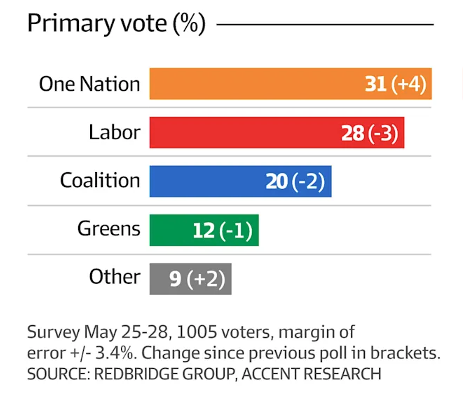
Employees might be suffering brain fry, but it looks like a lot of voters are experiencing this worrying mental condition too. And it has led them to support a party that once upon a time they would never have believed they could be at one with, but times have changed.
The leaders of Labor and the Coalition have shown themselves to be poor at representing a very large group of Australians and this has undermined their credibility and explains why Pauline Hanson’s party is on the rise.
As Maher might say: “Losers, lose.”
One final point and it looks at the pressure people were under in the old days compared to nowadays.
The famous Australian cricketer, Keith Miller, who also served as a pilot in World War II, was asked about pressure of playing Test cricket and this is what he said:
“Pressure is a Messerschmitt up your arse. Playing cricket is not.”
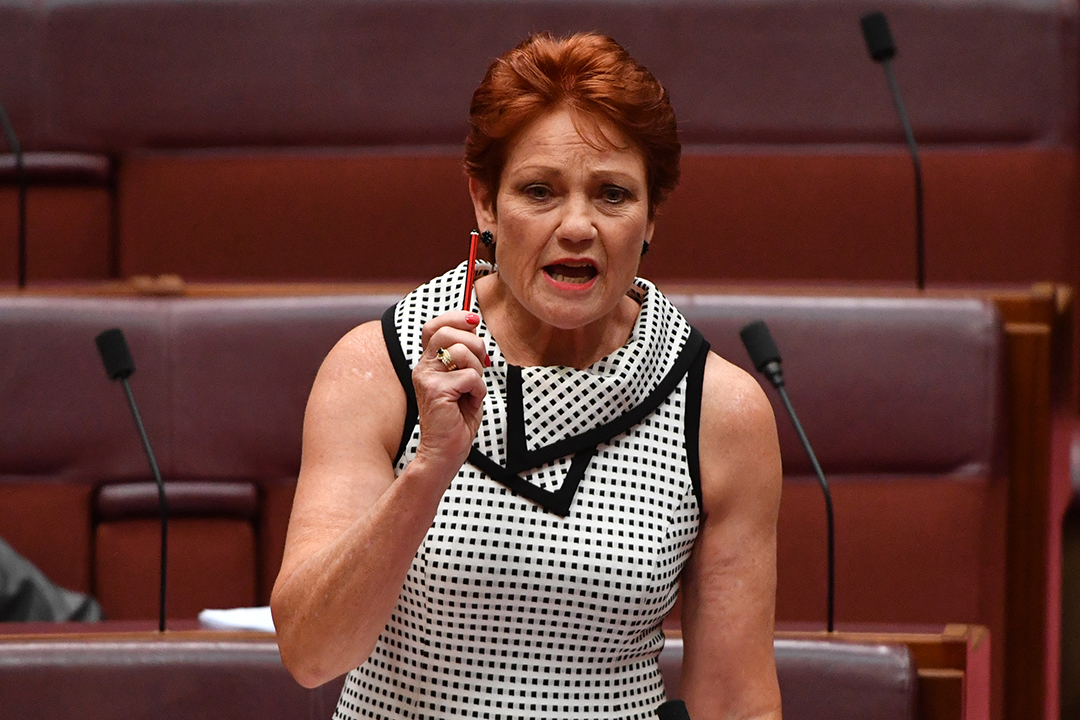
You’re spot on when you say that ‘common sense’ – isn’t common anymore
Spot on when you say that ‘common sense’ isn’t common anymore
“Employees might be suffering brain fry”
What about the continuing propaganda, fear porn, climate propaganda that is junk science.
What about the massive covid fear porn propaganda driven by a junk PCR test that gave 95% false positives due to the test being intentionally run at excessive amplifications.
What about the criminal ‘safe and effective’ campaign that encourages people via the same fear propaganda to take an injection that caused neurological damage among a long list of adverse effects including death.
What about the continued growth in government that is sucking the very like out of the economy forcing and ever-increasing percentage of the public to live in cars, tents and to eat out of rubbish bins.
What about the continued deliberate importation of barbaric people who hate western Christian democratic values, destroy social cohesion and end up on terror watch lists.
John
John
best comment ever, well done John
i read your items everyday so this is a friendly retort . my first impresion is one of elitism. im thinking about PH ,not joining, but considering. i feel you are talking down to me. i may be doing better in the stock market than you[judging by what you print],i am a rusted on liberal, i am a memberof the LNP,i know DC.so i dont think im brain friedjust because i think about ,consider,what her party is espousing. but a lot of people iknow whoare wealthy,well off, middle class, working class,tradies, smallbusiness owners,landlords ,retired, SF retirees,pensioners et al, arescreaming out for some conservative group or party to SAY THE SAME THING ! actually Dutton was our great hope.replying from the only liberal state on the mainland, capice ?
Peter
Thanks for an article based on common sense. The underlying problem with compensation you describe is also one contributing to the NDIS blowout.
There are ups and downs in life and things don’t always go your away. Luck sometimes goes your way and other times does not. There are winners and losers. C’est la vie.
Farmers are dependent on the weather.
Businesses may depend on overseas markets which can turn e.g. China – wine, lobsters, barley
etc, etc
Governments assistance should be directed to those who have have done their best to deal with a significant problem or where it is clear that individauls/communities cannot deal with the consequences (e.g major floods, fire damage, significant industry dislocation, persons who have significant injury/handicaps/illness) .
And employers shouldn’t be responsible for the personal problems of their workforce except where the behaviour is clearly outside the norms and a primary cause.
No surprises here Peter. But you say Albanese may be UNAWARE the effect his policies are having on the current issues facing our nation
I would argue that he is very much aware of what is going on. It’s just that his beliefs system and narrative is skewed towards his survivorship and legacy of being a longer term PM for the country – similar to Hawke
He does not give a dam for the greater health and prosperity of the nation
Luv you concluding comments having a Messerschmitt up your arse.
All forms of compensation that provide money for maximising and perpetuating illness and injury will eventually become unsustainable. Mental stress and psychological injury didn’t exist in these schemes 40 years ago but have fast become one of the biggest drains on the compensation funds. Schemes include extra lump sums payments for permanent incapacity, again encouraging maximisation of disability to attract greater monetary gain. Financial reward for maximising incapacity is a recipe for disaster. The schemes need to reward individuals for recovery milestones, not the opposite as is currently the case. Where will this all end up?
One item which is overlooked in the war between the generations, is that compulsory superannuation started in 1992. It was at 3% and was a wage rise foregone. It slowly rose over the years to the now level of 12%. That means that many older workers had no superannuation for many years and then only a small contribution for quite a number after. Therefore many, who are now being pilloried as being greedy, don’t have much saved for their old age. We were told to look after ourselves.
I can remember having a philosophical argument with my dad not long before he died.
At the end of it he said to me;
“yeah, me, my mates, and probably most of my generation ARE racist, homophobic, nationalistic dinosaurs. But we are quite happy for you to have, and to listen to, your opinion, even though it is opposite to our own. We don’t tell you that it’s inappropriate for you to have that alternate opinion, nor have we passed laws to stop you from publicly expressing it. So you tell me boy, who is the real intolerant one here?”
Presumably Pauline Hanson is the Messerschmitt?
It’s a fair dinkum worry that common sense has gone out the window, but do you reckon the major parties are actually listening to battlers who are feeling the pinch? Regards Telkom University Jakarta