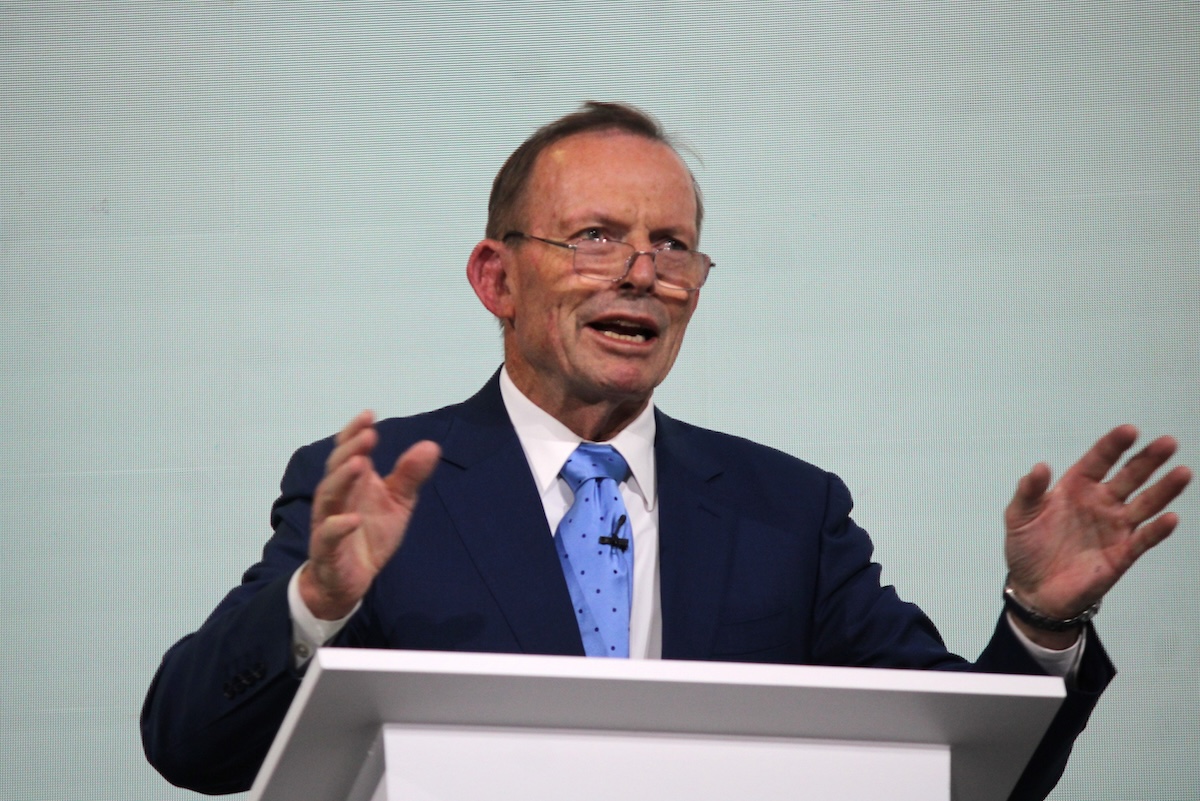
Former prime minister Tony Abbott will be the new federal president of the Liberal Party.
He has been nominated unopposed and will be installed when the party’s federal council meets in Melbourne on Friday.
The choice of Abbott, 68, for the post has the support of Liberal leader Angus Taylor but more moderate Liberals are concerned.
They fear the former leader, who retains a high public profile and very firm views, may be often in the news and take attention away from Taylor. They are also worried that Abbott, who argues the Liberals must have distinct, clear cut positions, will drive the party further to the right.
His supporters point to his indefatigable energy and say he will put more life into a demoralised and weak party organisation.
Abbott replaces John Olsen, a former South Australian premier, in the presidency.
Abbott was prime minister from 2013 to 2015, when he was ousted by Malcolm Turnbull.
He won in a landslide but his government came under immense criticism in 2014 for its harsh budget, which went back on commitments made in the election campaign. Reactions to that budget have been referenced in recent days as the Albanese government has suffered a backlash to its budget.
There had been speculation that former foreign minister Alexander Downer might run for federal president, but Abbott clearly had the support. Instead, Downer is standing for a vice president position – nominated by his daughter Georgina, who heads the Robert Menzies Institute. There are five nominations for the four vice president positions so it will be a contest.
In another significant change, the party’s federal director Andrew Hirst is leaving his job soon after the council. A replacement is not yet appointed.
The Victorian party recently brought back another major player of the past, when it installed former federal director Brian Loughnane as state president. Loughnane brings extensive campaigning experience, at a time when the Victorian Liberals are struggling to get their organisation into shape for the November state election.
Abbott takes over when the Liberals are facing a huge threat from the surge of One Nation, which will be a talking point among delegates to the council.
Earlier this year Abbott said the Liberal Party should not be “One nation-lite”.
It “should not be Labor-lite. We should not be teal-lite. We should not be One Nation-lite,” he said.
“We should be strongly Liberal, the Liberal Party of Menzies and Howard.
“I think that’s the best way to deal with the challenge from all the various parties, including One Nation.”
Michelle Grattan, Professorial Fellow, University of Canberra
This article is republished from The Conversation under a Creative Commons license. Read the original article.