Petrol prices in Australia have just topped $3 a litre in some areas, as pumps begin to run dry in regional areas and the Government rolls out plans to stabilise supply with so-called ‘dirty fuel’. But the data shows it could be worse compared to other countries around the world.
Australia’s national average petrol price sat at $2.08 per litre as of 16 March 2026, according to GlobalPetrolPrices.com. That places us in the middle of the global pack, below the world’s most expensive markets and well above the cheapest. But motorists locally still don’t have it easy, as the data shows spikes across the globe.
Trading Economics recorded petrol prices across major economies in February 2026 in US dollars per litre. Converting those figures to Australian dollars at the prevailing February exchange rate of approximately 69 US cents, then comparing them against the GlobalPetrolPrices data from 16 March, shows how much ground has been covered in under a month.
Australia’s price rose from around $1.77 per litre in February to $2.18 by mid-March, an increase of roughly 23 per cent. The United States moved from approximately $1.12 to $1.47, up around 31 per cent. The United Kingdom tracked from $2.59 to $2.87, a rise of about 11 per cent.
At the extreme-low end of the spectrum, Libya records the lowest pump price on earth at just $0.06 per litre, a figure sustained by government subsidies that keep domestic fuel artificially cheap. Iran, Venezuela and Angola cluster below $0.10 per litre for the same reason (these are not free-market prices).
At the high-end, Hong Kong motorists are paying $3.99 per litre, the highest recorded in the dataset. Iceland ($3.40), Switzerland ($3.03), and several Western European nations including the Netherlands ($3.08) and Denmark ($3.00) also exceed the $3 mark. In those markets, fuel excise and carbon levies are primary drivers.
The United States, often used as a benchmark by Australian motorists, sits at $1.91 per litre. The UK records $2.87, Germany $2.86, and New Zealand $2.47.
Within our region, Singapore comes in at $2.91, while Japan sits at $1.84 and Thailand at $1.76.
Petrol prices, 16-Mar-2026
Litre, Australian Dollar
| Libya | $0.01 | |
| Iran | $0.04 | |
| Venezuela | $0.05 | |
| Angola | $0.08 | |
| Kuwait | $0.40 | |
| Algeria | $0.45 | |
| Turkmenistan | $0.60 | |
| Egypt | $0.61 | |
| Kazakhstan | $0.52 | |
| Qatar | $0.63 | |
| Saudi Arabia | $0.82 | |
| Bahrain | $0.88 | |
| Russia | $1.14 | |
| Colombia | $1.15 | |
| India | $1.49 | |
| USA | $1.47 | |
| South Africa | $1.59 | |
| Chile | $1.70 | |
| Brazil | $1.73 | |
| Philippines | $1.75 | |
| Japan | $1.81 | |
| Thailand | $1.91 | |
| Turkey | $2.06 | |
| South Korea | $2.10 | |
| Mexico | $2.12 | |
| Australia | $2.18 | |
| Cameroon | $2.21 | |
| New Zealand | $2.28 | |
| Bahamas | $2.31 | |
| UK | $2.54 | |
| Sweden | $2.64 | |
| Austria | $2.68 | |
| Belgium | $2.72 | |
| Italy | $2.83 | |
| Portugal | $2.86 | |
| France | $2.91 | |
| Greece | $3.02 | |
| Switzerland | $3.07 | |
| Germany | $3.08 | |
| Israel | $3.11 | |
| Norway | $3.17 | |
| Netherlands | $3.32 | |
| Singapore | $3.42 | |
| Denmark | $3.51 | |
| Iceland | $3.60 | |
| Hong Kong | $3.93 |
Source: GlobalPetrolPrices.com. Prices as at 16 March 2026. Selected countries shown. Australia highlighted.
Source: GlobalPetrolPrices
The data suggests that while $3 per litre is a psychological threshold for Australian consumers, it remains below the cost that European and East Asian markets have managed as a structural reality for years. The difference, in most cases, comes down to fuel excise policy and the degree to which governments choose to absorb or pass through global crude costs.
For Australian drivers, the more relevant comparison may be domestic. The national average masks meaningful variation between capital cities and regional areas, where supply constraints and logistics costs can push prices considerably higher, as recent shortages in some areas have demonstrated.
It is also worth noting that the GlobalPetrolPrices.com figure for Australia was captured closer to the beginning of the Iran conflict, before its full effect on global supply had worked through to domestic prices. The NSW Government’s FuelCheck dashboard shows regular 91 unleaded sitting at $2.36 per litre in Sydney as of the time of publication.
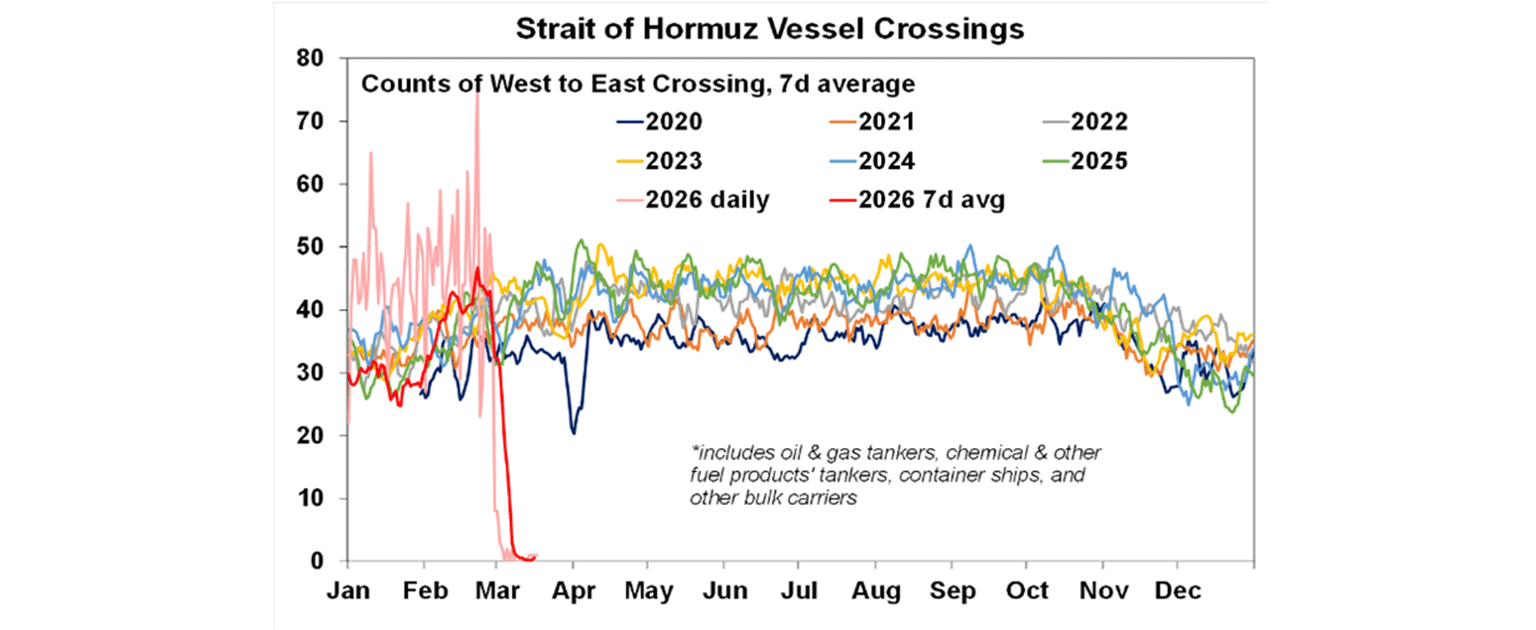
Prices show no sign of stabilising. Crossings of the Strait of Hormuz are sharply down as the area has become perilous for ships transporting crude oil out of the region.
Source: AMP
AMP Chief Economist Dr Shane Oliver addressed the outlook directly in his 17 March weekly report:
The longer oil supply is constrained the more oil prices risk going even higher and could reach say $US150 a barrel even if the War ends next month. This could add roughly another 50 cents a litre to petrol prices, adding another 0.7% or so to inflation.
The longer this persist the more there will be some flow through to higher underlying inflation via higher costs for transport (eg airlines and groceries) and products like plastic. Underlying inflation may also be boosted if fuel shortages lead to supply side problems.
And with Australian inflation already above target and now likely to be more so the greater the risk that this will flow through to higher inflation expectations leading to higher wage demands and business being more inclined to put through bigger price rises. The longer inflation stays above target, and it now looks like doing so for five of the last six years including the present year, the more people will expect it to stay above target and the harder it will be for the RBA to get inflation back down.