
Not Bill Shorten again! He’s a Labor guy who likes tapping into other people’s money and he’s at it again.
Former Labor PM-in-waiting, Bill Shorten, has shown that old habits die hard with his idea to slug companies with a 1% tax on their profits to bankroll a sovereign wealth fund to reduce the student debts linked to HECS. For students lumped with big education debts, it’s a great vote catcher, showing Bill’s still a Labor guy, who likes tapping into other people’s money.
The AFR’s Ronald Mizen looked at Shorten’s one year anniversary speech as Vice Chancellor of the University of Canberra and here are the main points:
- Companies benefit from the education system in hiring quality students, so they should pay up.
- In 1990, the Government paid 90% of student costs but now this is down to 50%.
- Teaching STEM — science, technology, engineering and maths — as well as AI and trauma-informed healthcare is a national priority.
- Universities are over-dependent on foreign student fees.
- A 1% tax would raise $5 billion a year for Shorten’s sovereign wealth education fund, which would be like the Future Fund that was created to cover the then growing unfunded debt linked to public servants’ super.
His call to help students is timely, with the Bankwest Curtin Economic Centre’s April 2025 Report: Youth in Focus: Navigating Wellbeing in a Changing World highlighting an increase in the incidence of financial stress in recent years for those in the younger generations. And Consumer Price Index (CPI) data shows tertiary education and housing costs rising particularly strongly over the past decade.
Changes to CPI and selected sub-group indices (2010-2024)
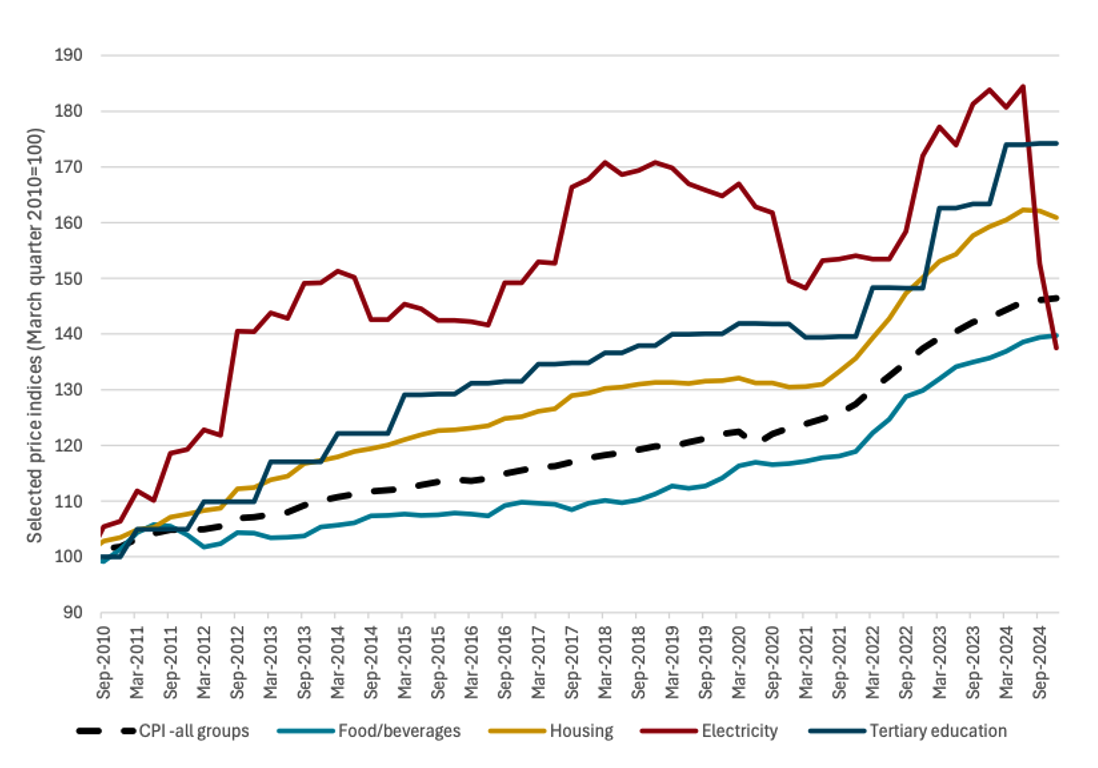
Source: Bankwest Curtin Economics Centre | ABS 6401.0 Consumer
Price Index Australia
Over 40% of the current youth group are expected to go to university and incur student debts under the Higher Education Loan Program (HECS-HELP).
On the most recently available figures, the total outstanding HELP debt reached $81 billion in 2023-24 across 2.9 million individuals, equating to an average debt of $27,650.
So, Shorten has identified a problem but is this the best solution?
Should all companies pay for educated students, after all, they do pay by via high wages. Why shouldn’t there be higher taxes on ex-students that end up on salaries over $300,000 a year?
While that’s not my idea, many would ask this question, especially when you look at top executives on multi-million dollar pay packets.
Or better still, why don’t Governments spend money better so that the current budget deficit over $36 billion can find money to reduce HECS debt, rather than unproductive, political handouts that help garner votes rather than productivity.
Also, we have about 2.5 million companies that are called small businesses, so would this 1% tax slug hit small businesses too?
Media mogul Kerry Packer once told a House of Representatives Select Committee on Print Media in 1991: “I am not evading tax in any way, shape or form. Now of course I am minimising my tax and if anybody in this country doesn’t minimise their tax they want their heads read because as a government I can tell you you’re not spending it that well that we should be donating extra.”
It’s nice that Bill Shorten cares about the students he now leads, but in a country where his own old colleagues are hoping productivity will lift to reduce costs and inflation, as well as boosting profits, economists would have to ponder the good sense of hitting job creating businesses with a new tax.
Better the Government spends better and helps businesses be more productive, say by encouraging workers to come to work, which might raise profits and tax collections, which then could be used to lower HECS and help those with related debt stress.
Thinking about Bill Shorten, here’s a longer version of the old saying I started this piece with: “Old habits die hard and if you’re not careful, the person you used to be can overtake the person you’re trying to become”.
Taxing business is an old idea. Here’s a new one: maybe universities should be given more entrepreneurial freedom to solve their own funding problems, which might save government funds that could be used to help reduce HECS debt.
While perhaps we should help over-indebted ex-students, I’d like a great idea to make it happen, rather than a tax on all companies.

Further to your article and comments about Bill Shorten’s speech.
Every business funds its future. The business income of the Australian Government is taxes. If they educate people to get better jobs and earn higher income, then they should reap more in taxes in the long run. Charging university students before they have even started earning and then nobbling their early income years when they are starting life with marriages, mortgages and children is surely short term thinking.
Bill Shorten was the architect of the NDIS and we know where that funding ended up. Tell him he is dreaming.
Redistribution of wealth to the young in some form is going to have to occur if we are to remain a largely integrated and cohesive society
It probably will involve taxing the very wealthy more!